
A Real-World Guide to Shooting the Streets (With Risk Levels) in Mexico City and EDOMEX
Mexico City is one of the most visually dense places on the planet. Layers of chaos, rhythm, contradictions. It’s a dream for street photographers.
To start this, let’s be honest: it’s not a playground.
This guide is built from real experience and grounded context. No romantic nonsense. Just where to go, what to shoot, and how much risk you’re actually taking. Please note: this is guide made through the direct experience in years shooting these locations.
Mexico City (CDMX)
Centro Histórico (Downtown)
Photography type: Street Photography
Risk level: ★★★☆☆ (Medium)
This is where everything starts.
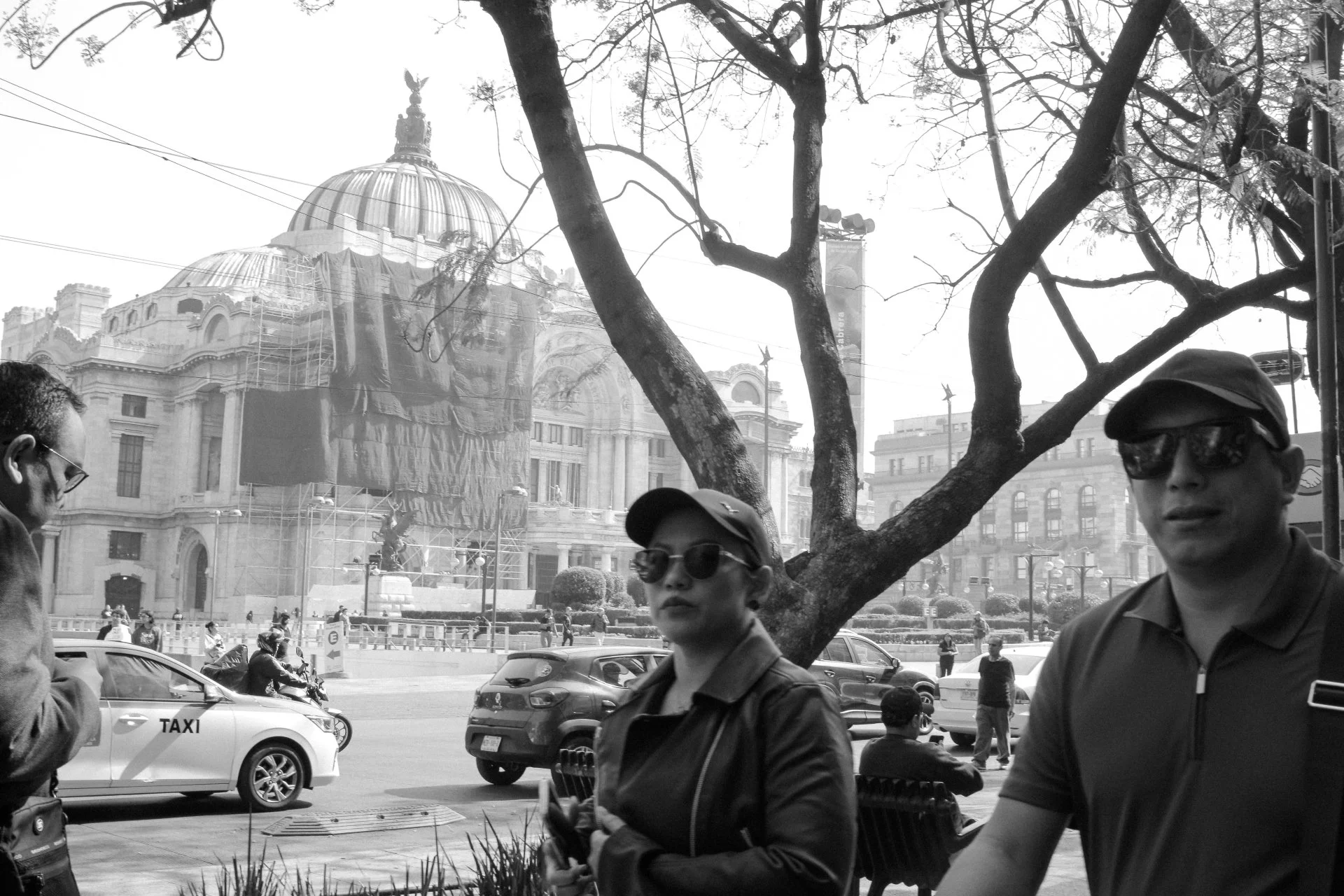
Colonial architecture, street vendors, religious processions, informal economy, tension between tourism and survival. It’s visually overwhelming in the best way. Everything is happening here.
During the day, it’s extremely active and relatively safe thanks to constant foot traffic and police presence. Centro Histórico
But things change fast after sunset. Some streets empty out, and petty crime becomes more likely.
What to shoot
Layered scenes with vendors and pedestrians
Religious symbolism vs daily life
Human density, tension and chaos
How to work
Keep your camera visible but not flashy
Stay in motion
Avoid empty streets at night
Roma / Condesa
Photography type: Street + Urban Lifestyle
Risk level: ★☆☆☆☆ (Low)
If you want control, this is your base.
Tree-lined streets, cafés, clean geometry, softer light. This is where you can slow down and observe instead of react.
These neighborhoods are among the safest in the city, thanks to constant activity and “eyes on the street.”
What to shoot
Clean compositions
Isolated figures
Subtle gestures
How to work
Take your time
Shoot more deliberately
Good place for longer lenses and patience
La Merced / Tepito edges
Photography type: Raw Street Photography
Risk level: ★★★★☆ (High)
This is where things get real. And so exciting.
Markets, informal trade, intensity. Visually insane, ethically complex.
Pickpocketing and tension are part of the environment, especially in crowded areas.
What to shoot
Faces
Transactions
Human friction
How to work
Go light
No distractions
Ideally not alone, especially if you are a stranger
Zona Rosa
Photography type: Street Photography + Urban Lifestyle
Risk level: ★★☆☆☆ (Low–Medium)
Zona Rosa sits somewhere between chaos and control.
It’s not as polished as Roma or Condesa, but not as raw as Centro Histórico. It’s layered in a different way: nightlife, tourism, LGBTQ+ culture, street commerce, and a constant sense of performance.
During the day, it can feel almost quiet. But at night, everything shifts. Neon lights, bars, movement, characters. That’s when Zona Rosa becomes visually interesting.
Safety is generally acceptable, especially in the main streets, but like any nightlife area, things can escalate late at night. Alcohol, crowds, and distraction change the dynamics. Beware the exits around the Glorieta.
What to shoot
Night scenes with artificial light
Portraits of characters and subcultures
Interactions outside bars and clubs
How to work
Night shooting is where it shines
Stay aware of your surroundings at all times
Keep gear minimal and easy to manage
Polanco
Photography type: Urban Landscape + Street (Controlled)
Risk level: ★☆☆☆☆ (Low)
Polanco is not about chaos.
It’s about control, wealth, and silence.
Wide avenues, luxury storefronts, corporate architecture, polished surfaces. Everything feels designed, intentional. Even the randomness is curated.
From a street photography perspective, this is not a place where things happen fast. It’s a place where you have to slow down and see differently.
Security is high. Private guards, surveillance, constant presence. It’s one of the safest areas in Mexico City, but also one where you’ll feel watched.
What to shoot
Minimalist compositions
Reflections and glass of buildings and cars
Isolated figures in structured environments
Contrast between workers and luxury spaces
How to work
Be discreet, not invisible
Avoid pointing the camera directly at security or sensitive locations
Work with patience and precision
Lindavista / Torres de Lindavista
Photography type: Urban Landscape + Street (Subtle)
Risk level: ★★☆☆☆ (Low–Medium)
Lindavista, especially around Torres de Lindavista, is about structure, routine, and middle-class stillness.
It’s not visually aggressive. It doesn’t try to impress you. But that’s exactly where the interest lies.
Wide streets, residential buildings, students, families, small businesses. Life here moves in patterns. Predictable, almost quiet compared to the rest of the city.
Safety is generally good, especially during the day. It’s a stable area, but like anywhere in Mexico City, things can shift at night in less active streets.
What to shoot
Repetition in architecture
Everyday routines and subtle gestures
Intersections of private and public life
Students and generational contrast
How to work
Slow down and observe patterns
Work with longer focal lengths for distance
Don’t force the frame, let it build
Montevideo / Basílica de Guadalupe
Photography type: Street Photography (Documentary) + Urban Landscape
Risk level: ★★★☆☆ (Medium)
This area revolves around one thing: belief.
The Basílica de Guadalupe is not just a landmark, it’s a constant flow of human devotion. Pilgrims, vendors, families, people arriving with hope, leaving with something else.
The energy changes depending on the day. On regular weekdays, it’s manageable. On religious dates, it becomes intense, almost overwhelming.
Montevideo and the surrounding streets are raw but functional. Not dangerous in an extreme sense, but unpredictable due to crowds, movement, and distractions.
What to shoot
Expressions of faith and exhaustion
Pilgrims and personal journeys
Religious symbolism vs street commerce
Human density and movement
How to work
Respect is everything here
Blend into the flow, don’t interrupt it
Stay alert in crowded situations (pickpocketing risk)
Work close, but with awareness
Santa María la Ribera
Photography type: Street Photography + Urban Landscape
Risk level: ★★☆☆☆ (Low–Medium)
Santa María la Ribera feels like a pause inside the city.
It’s historic, slightly worn, but still alive in a very local way. Less polished than Roma, less chaotic than Centro. It sits somewhere in between, and that’s exactly why it works.
At the center, the Kiosco Morisco acts as a visual anchor. Symmetry, geometry, people orbiting around it. It’s almost too perfect, which means you have to work harder to make it yours.
Safety is generally fine during the day, with families, students, and constant activity. At night, some streets become quieter and require more awareness, but nothing extreme if you stay within active areas.
What to shoot
Life around the Kiosco Morisco
Everyday neighborhood routines
Architectural details and textures
Stillness mixed with subtle human presence
How to work
Don’t rush, this area rewards patience
Avoid cliché compositions of the kiosk
Explore side streets for more authentic scenes
Let the scene build instead of forcing it
Estado de México (EDOMEX)
Now we step outside the “Instagram city.”
This is where your work can become truly different. This is where I photograph.
Tlalnepantla
Photography type: Urban Landscape + Street
Risk level: ★★★☆☆ (Medium)
Industrial edges, working-class neighborhoods, historical layers.
It’s not pretty in a conventional sense. But visually, it has depth.
Safety is considered moderate overall, with increased risk at night and in poorly lit areas.
What to shoot
Industrial geometry
Empty transitional spaces
Workers and routines
How to work
Daytime shooting is key
Avoid isolated zones after dark
Move with purpose
Naucalpan
Photography type: Urban Landscape
Risk level: ★★★★☆ (Medium-High)
A fragmented city.
From middle-class suburbs like Ciudad Satélite to more complex zones, it’s visually inconsistent and that’s exactly the point.
Some areas are safe and structured, others less so. Certain neighborhoods are best avoided due to higher crime rates.
What to shoot
Contrasts between wealth and decay
Suburban emptiness
Architectural identity
How to work
Scout first
Avoid looking lost
Blend in
Cuautitlán / Cuautitlán Izcalli
Photography type: Urban Landscape
Risk level: ★★★☆☆ (Medium)
This is not a tourist space. It’s everyday Mexico.
Residential grids, highways, industrial sprawl. Not visually “obvious”, but full of meaning if you know how to look.
Safety is mixed. Some calm areas, some rougher zones. Movement with awareness is essential.
What to shoot
Repetition and urban monotony
Social infrastructure
Quiet human presence
How to work
Shoot with intention, not curiosity
Avoid wandering randomly
Respect the rhythm of the place
The Reality of Shooting Here
Mexico City is not dangerous in a simplistic way.
It’s selectively safe.
Some neighborhoods like Roma, Condesa, and Polanco are consistently safe even at night, while others require awareness, especially after dark.
The biggest risk is not violence.
It’s distraction. And believe me, this is a great thing considering we are talking about a city of 23 millions of inhabitants. I can’t figure out what could be Rome, Italy with that number.
Practical Rules (That Actually Matter)
Don’t look like a tourist
Don’t hesitate in the street
Body language communicates, if you have fear, that is a call for bad people
Don’t overthink your shots
Don’t flash expensive gear unnecessarily
Use Uber or Didi when moving between areas
And most importantly:
If a place feels off, it probably is. Leave.
Final Thought
If you only shoot in the safe zones, you’ll get safe images.
If you push a bit further, with awareness, not ego,
Mexico City and EDOMEX will give you something else entirely.
Not just photographs.
But tension, meaning, and truth.
If you don’t feel sure, maybe to go with a local is better. That is where I can be your solution because I am a photo coach, as you know.
Want to Go Deeper? Work With Me in Mexico City
Reading about these places is one thing. Working them in real time is something else entirely.
If you’re coming to Mexico City and want to move beyond random shooting, I offer 1:1 photo coaching sessions designed around your level, your eye, and your way of working.
This is not a generic photo walk.
We’ll go into the streets with intention. I’ll help you understand how to read a scene, anticipate moments, build layers, and most importantly, develop your own visual language without forcing it.
Sessions are available across key areas of the city like Centro Histórico, Zona Rosa, Polanco, and Santa María la Ribera.
For more experienced photographers looking for something different, I also offer custom experiences in selected areas of EDOMEX including Tlalnepantla, Naucalpan, and Cuautitlán. These are not for everyone, but if you’re interested in working in more complex environments, they can be incredibly rewarding.
Each session is tailored. No presets, no formulas.
Just real photography, in real situations.
If this sounds like your way of learning, get in touch.