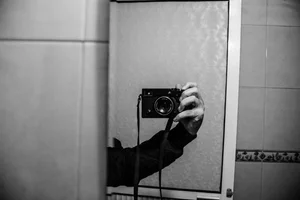

How is the 40mm 2.8 doing on the 5D?
I would say that this photo can well represent this short piece here.
A few weeks ago I picked up the Canon 40mm 2.8, a fantastic little pancake to shoot with on a full frame body meant for war: yes, I put it on my 5D Mark II. Not a new R body with a silent shutter and a screen that flips for the Instagram crowd. The old heavy brick. The one that sounds like a door slamming when you press the shutter.
40mm is a strange number on paper. Too long to be a 35, too short to be a nifty fifty, sitting in that no man's land that lens reviewers love to dismiss as "not quite anything" I watched videos from a guy, Robin Wong: he hates the 40mm focal lenght. But it is me and on the street, though, it's the way I actually see. Wide enough to hold a scene together, tight enough that I'm not stretching a corner of a market stall into some fisheye caricature. It's close to how my eyes read a street when I'm walking through it, which is the only argument for a focal length that actually matters to me. Everything else is spec sheet talk. I don’t care most of street photographers shoot today with the 28mm. I am not…the other street photographers.
The 40 pulls things in just enough. It forces me to commit to what the frame is actually about instead of hiding behind context.
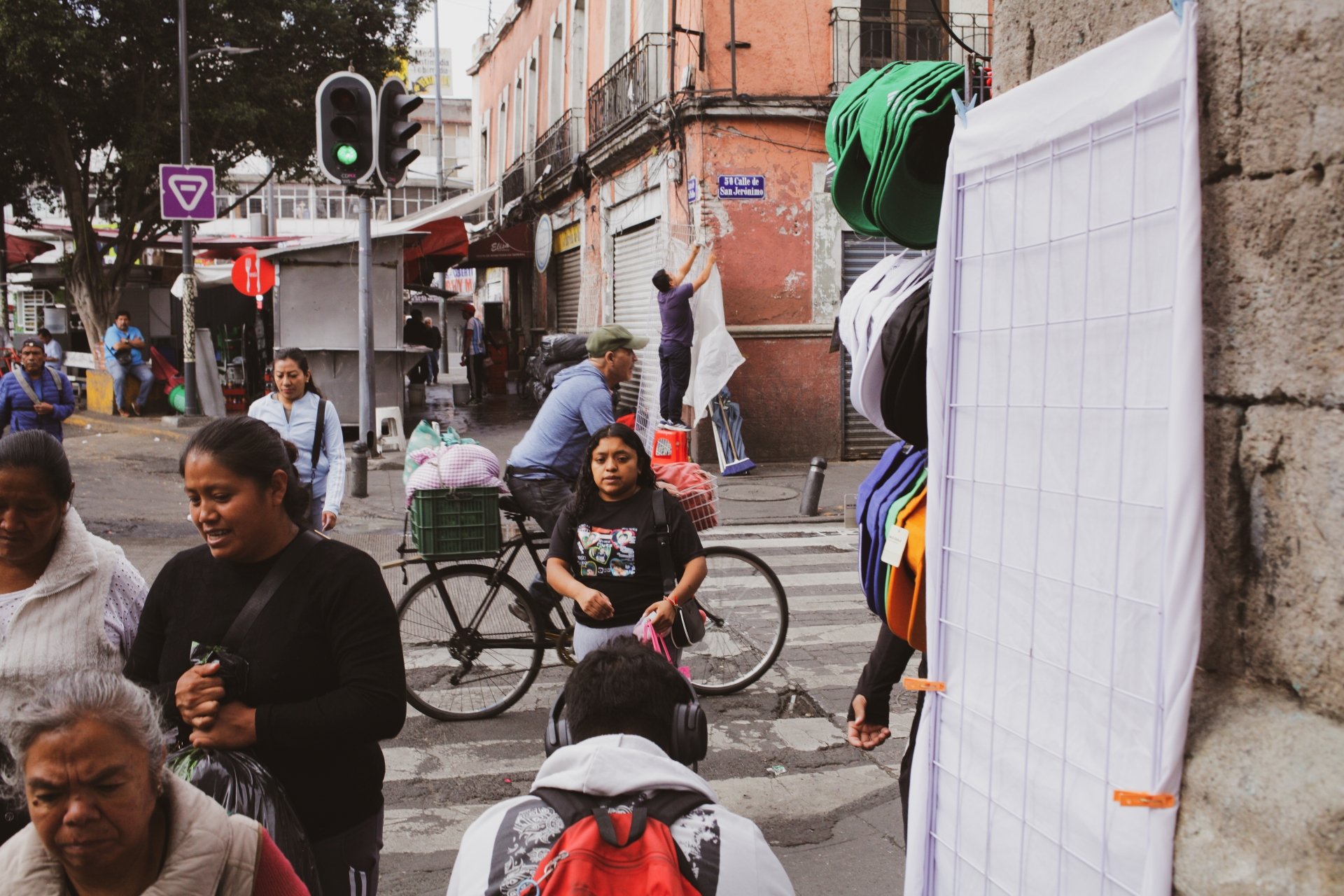
Here's the part nobody tells you when they sell you a pancake lens: strap it to a 5D and you haven't made yourself small. The lens is compact. The camera absolutely is not. You're still holding a black brick with a grip, a prism hump, a shutter that announces itself to the entire block. In Centro, on a corner like 5ª Calle de San Jerónimo, close to San Pablo a famous street where there is a big bicycle market, that sound carries. People turn. Vendors clock you before you've even raised the camera to your eye.
There's a whole cult of street photography built around invisibility: the tiny mirrorless, the silent shutter, the "nobody knew I was even there" school of thought. I get the appeal, and I've flirted with it so many years. But the 5D forces something different on me. I can't disappear. I have to own the fact that I am a photographer standing in someone's street, pointing a very visible machine at their morning. It changes how I move. It makes me responsible. It forces me to be present. I stop trying to steal moments and start negotiating for them, a nod, a half second of eye contact, sometimes just the confidence of not flinching when someone looks straight into your lens. It's a harder way to work. It's also a more honest one. I'm not hiding what I do, so the street doesn't have to guess.
Take this shot I made at that corner in Centro. San Jerónimo street. Crossin street. The ViaVai.
That's four or five separate depths of information stacked in one 40mm frame, and none of them fighting for attention because the lens doesn't distort or compress them into a flat mess. Foreground stall goods, midground crossing, background facade and rooftop, and somewhere in the gaps between all of it. That's Centro on a normal day. That's why I don't want a focal length that flattens it into two planes. I want the layers.
Honestly, this lens doing exactly what I hoped. It's not making me faster. It's not making me invisible. What it's doing is giving me a frame that matches how close I actually want to stand to people, on a body that refuses to let me pretend I'm not there. Between the two of them, something clicks. Not comfort, exactly. More like the right kind of friction.
I'll keep shooting it this way for a while. I will keep you updated.