Fuck the History of Photography. Signed: A Journalist.
"Let's normalize not photographing strangers without permission."
Written by a journalist. Not by an influencer chasing easy applause. Not by some random user mistaking control for ethics. By a journalist.
Even worse.
So my reply there:
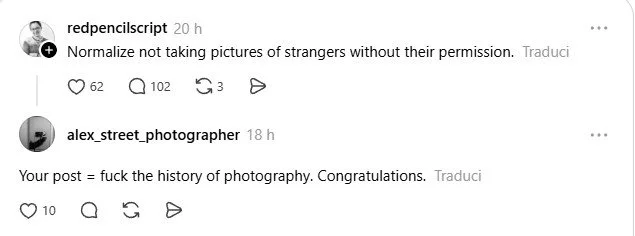
Because a street photographer who says this is simply ignorant of his own discipline. A journalist who writes it is ignorant of his own profession. And here it stops being a social media joke. It becomes a problem.
There's one good thing, though: she doesn't speak for all of journalism. I work with reporters who watch me shoot without permission all the time. There's a word for that. Photojournalism.
The permission that never existed
Let's ask it straight: how many photographs that defined the twentieth century were taken with a signed release in someone's pocket?
Henri Cartier-Bresson didn't ask permission. Gianni Berengo Gardin didn't ask permission. Garry Winogrand didn't ask permission. Weegee, photographing corpses and onlookers in New York's underworld, didn't ask permission. Helen Levitt, the children of Harlem, didn't ask permission. The Magnum photographers in wars, riots, civil rights marches — none of them asked permission.
Street photography isn't a genre like any other. It's the act of stealing a moment from reality with no mediation, no posing, no polite filter. Take away the "without permission" and you don't get a gentler version of street photography. You get nothing. The same goes for documentary photography, by extension.
The paradox of those who should know better
A journalist knows, or should know, better than anyone: the photojournalism that changed history — war, famine, repression, protest — never waited for consent. It had the urgency to show. Full stop.
Normalizing the opposite isn't a kind gesture toward strangers. It's disarming journalism with journalism's own hands.
So here's the real question: is this about ethics, or is it about comfort? Because in most countries, you don't need permission to photograph in a public place. The law has been clear for over a century. What's missing isn't the right. It's the nerve to use it.
Two different things
Legal and ethical are not the same word. Confusing them is the cheapest rhetorical trick there is: "I can" becomes "I must," and "I must" becomes "I should never." One post, sixty-two likes, and a century and a half of photographic history gets thrown out.
No one's saying everything legal is automatically right. But the answer to abuse isn't erasing the genre. It's judgment. It's the eye behind the camera. It's the responsibility of the person shooting — not the pre-emptive surrender of the person who decided not to.
As a photojournalist, I'll say it plainly: stop writing nonsense that ignores the history of photography entirely. All you expose is your own ignorance.
Let's end it here
The history of photography is made of strangers photographed without permission. Take that away and all you're left with is an archive of agreed-upon smiles.
Fuck the history of photography, indeed. Congratulations.