The 40mm Manifesto: What Truffaut and Rohmer Taught Me About Street Photography
Mexico City, Downtown.
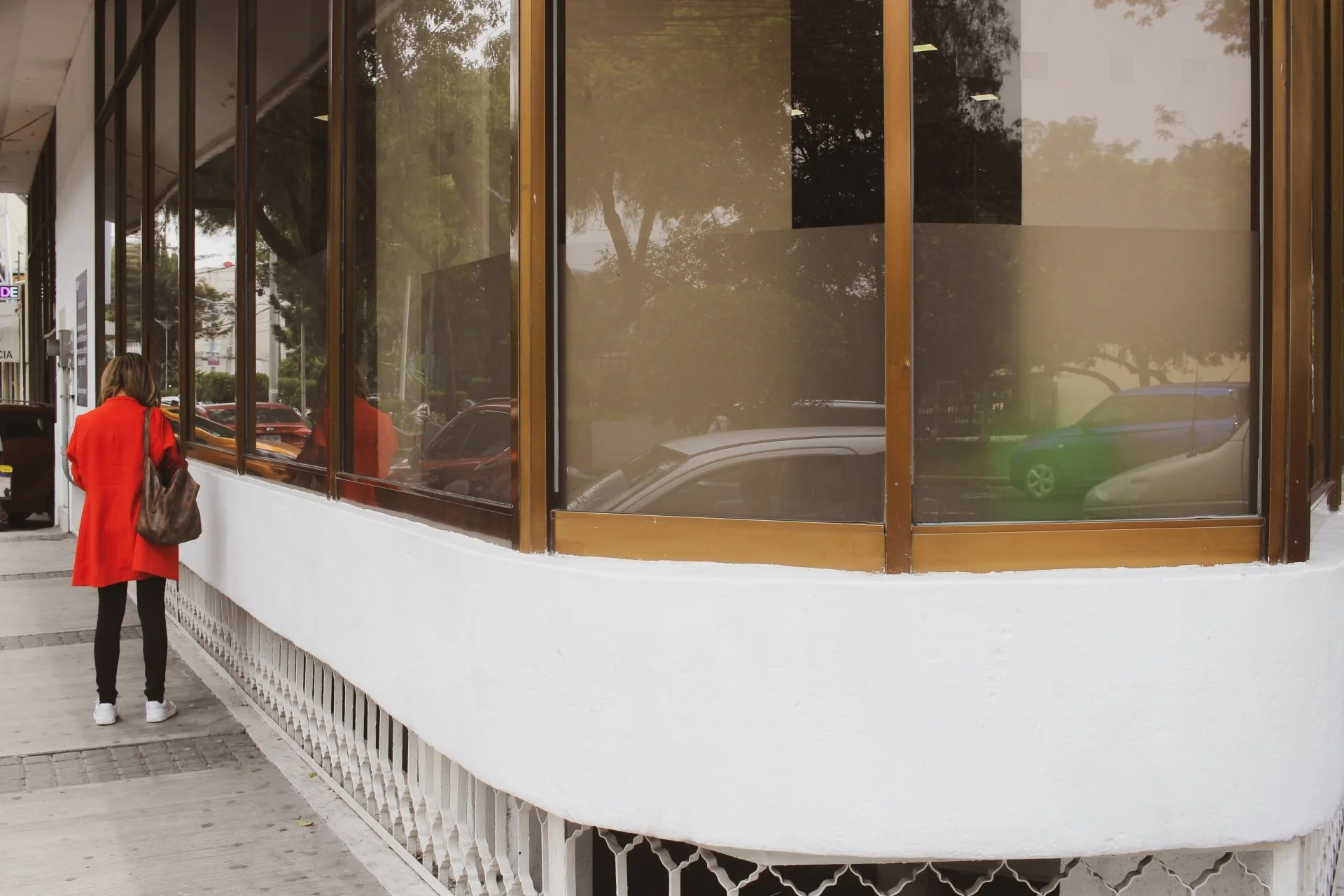
Mexico City, a sidewalk somewhere along a curved glass storefront. The light is doing that thing it does in autumn (it is summer really rain period here), low and gold and unforgiving. A woman in a red coat walks ahead of me, black leggings, white sneakers, a bag slung heavy over one shoulder, her back turned, her reflection doubled in the bronze-framed windows beside her, trees, parked cars, a whole street folded into the glass she isn't even looking at. I am eight feet behind her. Not fifteen. Not three. Eight. So I raise my camera. I don't zoom, because I can't , there's nothing to zoom. I don't step back to "get the composition." I don't step forward to "get the moment." I shoot from exactly where I'm standing.
That's the thing nobody tells you about a 40mm. It doesn't just frame the world. It tells you how close you're allowed to get to it.
Most conversations about street photography focal lengths are really conversations about ego. I am not interested to do the same here. 28m, 35mm, 50mm, what focal lenght is better for street photography? I don't think I can include the 40mm in that trivial topic. The 40mm is neither wide enough to declare itself an act of aggression, nor long enough to declare itself an act of detachment. It sits in a strange, almost uncomfortable middle distance that I feel more personal, close enough to be inside the scene, not so close that the scene notices you're there. It is like the eye. Exactly that middle distance, it turns out, is exactly where two of French cinema's most patient observers built entire careers.
Watch The 400 Blows again, specifically the way the camera stays with Antoine Doinel. Truffaut doesn't shoot him like a subject under observation. He doesn't hold him at arm's length the way a more clinical director might, and he doesn't crowd him with handheld urgency either. The camera simply walks alongside him, close enough to catch the flicker of a decision crossing his face, far enough to let him still be a boy in a world rather than a specimen under glass. The famous final tracking shot where Antoine running toward the sea, the camera keeping pace, refusing to cut, refusing to comment: indeed it is not spectacle. It's restraint disguised as movement. Truffaut trusts the run. He doesn't need three angles of it to make you feel it.
This is, I think, the closest thing photography has to a shooting philosophy I already believed in before I had the language for it: the single-frame mantra. I don't burst. I stay with the single shot most of the time. My 40mm (38.4mm in my Rebel T7) makes that discipline almost mandatory. You can't crop your way out of indecision. You're already exactly as close as Truffaut's camera was to Antoine, close enough to mean it, not so close that you've made the scene about your presence instead of its own.
Now…Truffaut gives me proximity, Éric Rohmer gives me something harder to name: patience as a form of respect.
Rohmer's Moral Tales are famous for almost nothing happening, visually. People talk. They walk along a beach, or sit in a kitchen, or argue gently about fidelity over a glass of wine, and the camera simply lets them. It doesn't push in for the emotional beat. It doesn't cut away when the conversation gets uncomfortable. It sits at what I'd call a conversational distance, near enough to be trusted with what's being said, far enough to never suggest it's steering the conversation itself. The charme I receive from the everyday and the mundane. That's the distance I'm after with a 40mm on a Mexico City street. I am talkinng about a conversational distance. Close enough that the frame becomes a kind of listening.
I think this is also why I've never been able to make myself like the "spray and pray" approach to street work. I am asking the street to be honest with me exactly once.
None of this is an argument for mysticism over craft. If anything, the opposite. My settings for street work are almost aggressively unromantic. Nothing about my setup is poetic.just an old camera and a pancake lens to get out of my way. And that's the part people miss when they talk about "vision" in photography as though it lives somewhere above technique, untouched by it. It doesn't. My vision is downstream of decisions like these, a focal length that won't let me cheat the distance. It requires presence. Presence and also respect, to respect the people and having in any case a certyaiin distance because I don’t make an intervention, I don’t want to create a moment because I am imposing myself and waiting a reaction. The technical rigor exists so the eye can behave like Truffaut's camera and Rohmer's patience at the same time: close, but not intrusive; still, but not passive.
I keep coming back to a phrase I use for my own work: a single frame that condenses an entire narrative tension, almost like the manifesto of a film that was never made. Truffaut and Rohmer made their films. I don't get that luxury, and I don't want it. What I get is one frame, one chance, one distance chosen in advance by a piece of glass that refuses to let me be anywhere other than exactly this close. A lens and a camera that I don’t need to think too much. The moment is the king. Any other element, to think about settings would be a distraction breaking that magic of the moment that I could loose the mment. No, I don’t want this happening. The woman in the red coat never turned around, as far as I know. I took the frame and kept walking behind her, the way Truffaut's camera kept walking with Antoine, the way Rohmer's camera kept listening on the beach. I never saw her face.
That's not a gap in the photograph.
That's exactly the photograph I wanted.