I need to explain this to you, my dear audience.
You know, I was an ambassador for Fujifilm Mexico for 6 years. Currently, however, I have no relationship with them whatsoever; in fact, after that experience, I feel I am about as far removed from being a brand ambassador as one could possibly be. I have no intention of returning to the role of ambassador for Fujifilm—or for any other brand, for that matter. So, what I am sharing here? My thoughts about my choice to back to work with a Fujifilm camera. I purchased it in the second hand market, of course. That is already a clear choice. In the past I owned a Fujifilm X100S. But to back after several years with DSLRS, with Olympus cameras and a Sony a6000, I can appreciate even more the experience to work with a X100 series camera. My words here go only towards users, the photographers, maybe those attending my workshops in the next future.
Why the X100T, specifically?
First of all, I don’t chase the latest model. My cameras are old and used. I really don’t need the last camera on the market to make my work. Prices are crazy right now and I am not going to spend all that money for a camera. Cameras are just cameras. Yes we can love them a lot. But I am not going to put a fucking name to a camera, that is just a tool. Today we have few photographers and a lot of camera testers, or consumers, just like the system loves. Too bad that a lot of these camera testers are also ambassadors. Anyways… yes, I am writing an article about a camera, but not with the usual approach we see on the internet. That is: I have no need for a camera with the most up-to-date technology.
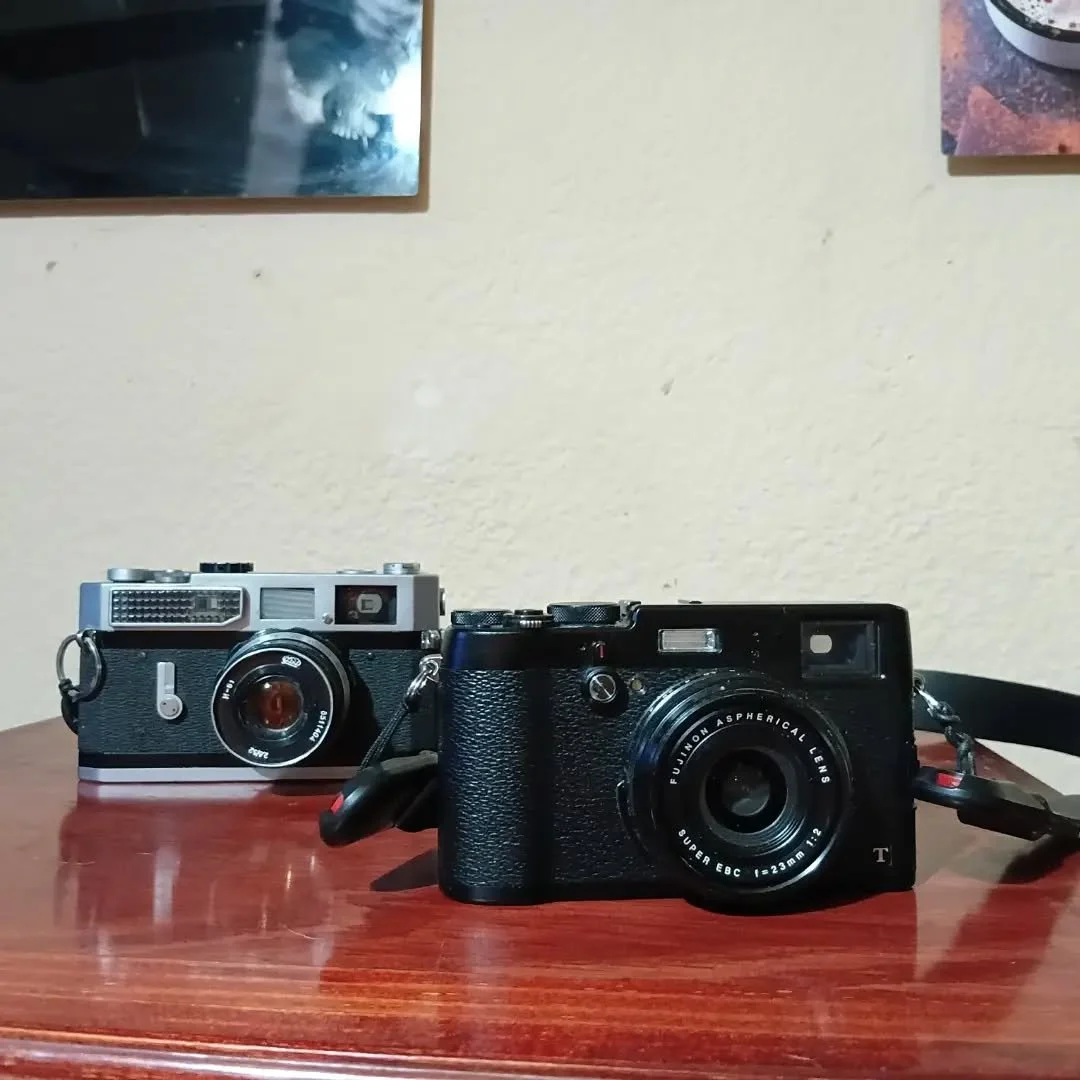
I consciously chose a used X100T. I made a list of cameras that I wanted to work with. All the cameras in my list should respond to my need of a everyday street photography camera. Because despite I showed in the last years that is possible to make remarkable work on the street even with a 5D, certain photos can be made only thanks to a camera that is small and discreet. I can see right now how I am back to a certain approach counting with a camera like this. And there is also the experiencial factor: to shoot with a vintage, rangefinder-like camera is a pleasure and I go more happy on the street taking pictures. Trust me: I could realize good stuff even with the Canon M200, a camera focused on content creators, but I really hate the touch screen. If I loved the touch screen maybe a smartphone could be enough, but that is with me: I want a camera that is… like a camera.
I am interested in the rendering of the first-generation 23mm f/2 lens. What interests me about the original 23mm f/2 lens used throughout the early X100 generation is not a supposed vintage look, but its particular optical behaviour. It has some limitations that I actually appreciate. Wide open, particularly when focusing at close distances, the lens can produce a softer rendering, with less pronounced detail and contrast towards the edges. Stop it down and it becomes considerably sharper, but its overall rendering remains distinct from what I associate with some newer digital optics. I am not suggesting that it is an inherently soft lens. It is perfectly capable of producing detailed, sharp images. What I appreciate is that it doesn't always deliver the kind of clinical crispness that has become so desirable in contemporary digital photography. And I think there is a difference between resolving detail and making every detail look aggressively sharp. I tend to prefer the former.
16 megapixels are more than enough for my work. Really. A camera should serve a vision, not the other way around.
My relationship with film
I don't expect a digital camera to reproduce the aesthetics of film. That would be a pointless exercise. But I believe that photography needs to have a certain aestetic that is more organic also when shooting digital. While many photographers love crisp and super detailed, I quite love the opposite most of the time. And I am a celebrator of the imperfection because I know how the important in photography has been always the imperfection.
I also own and use a Canon Model 7. A 35mm rangefinder, totally mechanical. Film photography profoundly influences the way I look at things and the way I take photographs.I am drawn to a specific film aesthetic: not just a generic "vintage" look, but a photographic rendering that is less aggressive, less clinical. Grain, imperfections, tonal transitions, texture, the relationship between light and matter to me. Film is neither a filter nor a simulation. That is where many photographers fail. It is not the recipe to give you the real result, but a way to think, an approach. So I think that sometimes it happen that a digital photograph is more “film” than a photograph made with a film camera. Film to me is a mindset.
I love to shoot with my rangefinder camera. And I love to shoot also with my Olympus Stylus Infinity. But, hey, prices of film stocks are crazy right now, so I can shoot few rolls per year. That is why I need a camera like the Fujifilm X100T.
Wit that said I am perfectly aware no digital sensor truly replicates the experience of film. Theentire structure of the image is different. I know also that silver-halide grain is not digital noise. The tonal transitions and the response to light are not interchangeable. So I put it clear here that I am not looking for an imitation: I am seeking a digital rendering that aligns more closely with my visual preferences.
Softness and organic quality
Sharpness is a technical quality. It isn't automatically a photographic quality. Those photographers shooting film know what I am talking about. I can see in my film photos a particular aesthetic rendering that is completely far from the digital. In film that sharpness is impossible to achieve it, and that is exactly where I see my problem with digital. I am sorry but I am not that guys looking in a monitor the photograph 400%. And even for prints…today it seems you are a mediocre photographer if you don’t impose yourself in a exhibition prints that are huge. Personally I hate also the televisions larger than 32 inches, but you know saller the brain (or the dick) and more people want bigger…it is a surrogate. I don’t need surrogates.
I do not consider absolute sharpness to be an aesthetic value. I do not like images that are overly crisp or sharp. I prefer a certain softness, provided it does not compromise the legibility of the image.
I am interested in detail, but without any artificial enhancement of that detail. The rendering of the X100T’s lens contributes to this preference. I do not wish to correct every characteristic of the camera.
My JPEG approach
You know, since 2013 I shoot exclusively in JPEG. That is I want to make the key decisions right there in the camera. I have no interest in artificially constructing an image during post-production.
I use Lightroom primarily for exporting and for a moderate final sharpening. My camera settings must be consistent with the result I am aiming for. I prefer to spend my time to make more photos and not staying too myuch in fron of a monitor to edit the photos. If you think this is a superficial way to work, well, thanks to my approach I am a real published photographer, and art directors hire me for my work.
My X100T configuration
Film Simulation: Monochrome + Yellow or Classic Chrome
Image Quality Fine JPEG
Sharpness 0
Noise Reduction -2
Highlight Tone 0
Shadow Tone 0
Color -1 (for Classic Chrome)
Dynamic Range DR100
ISO Auto 200–6400
Focus Manual / Zone focusing
Apertures f/5.6–f/8
The meaning of my choice
Ultimately, I don't need my digital camera to look like film. I just want its rendering to be compatible with the way I see photographs.
I am not trying to turn back the clock technologically. I do not consider older cameras to be automatically better. But they are cheap and I obtain virtually the same. With no consumer mindset, I can see the X100T can be a right alternative to the more expensive X100VI. It is not even a matter of analog romanticism. It is a matter of visual preferences. The X100T allows me to work digitally while maintaining a connection to a photographic aesthetic that I feel is closer to my own sensibilities. Expecially for a JPG shooter that is important. I am pretty sure that many photographers felt deceptioned by Fujifilm with the proposal of X Half because the camera is a only JPG camera. I believe that camera is quite interesting: for the price but expecially for the concept. I think that is a funny camera that I can consider in the future.
For my editorial work I have my DSLR cameras. Finally, after a list of cameras where I included also the XPro, I decided that really I didn’t need of another interchangeable-lens system for my street photography, and the X100T looked to be a natural choice for my photography.
I hope you enjoyed this article. Let me know in the comments.