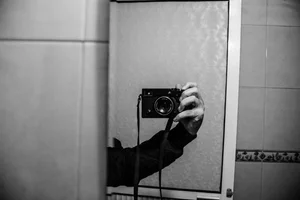

GEOGRAFIE: Places, Distance, and the Human Landscape
PLEASE NOTE: THIS ARTICLE HAS BEEN PREVIOUSLY PUBLISHED ON SUBSTACK. BUT I NEED TO PUBLISH IT AGAIN HERE.
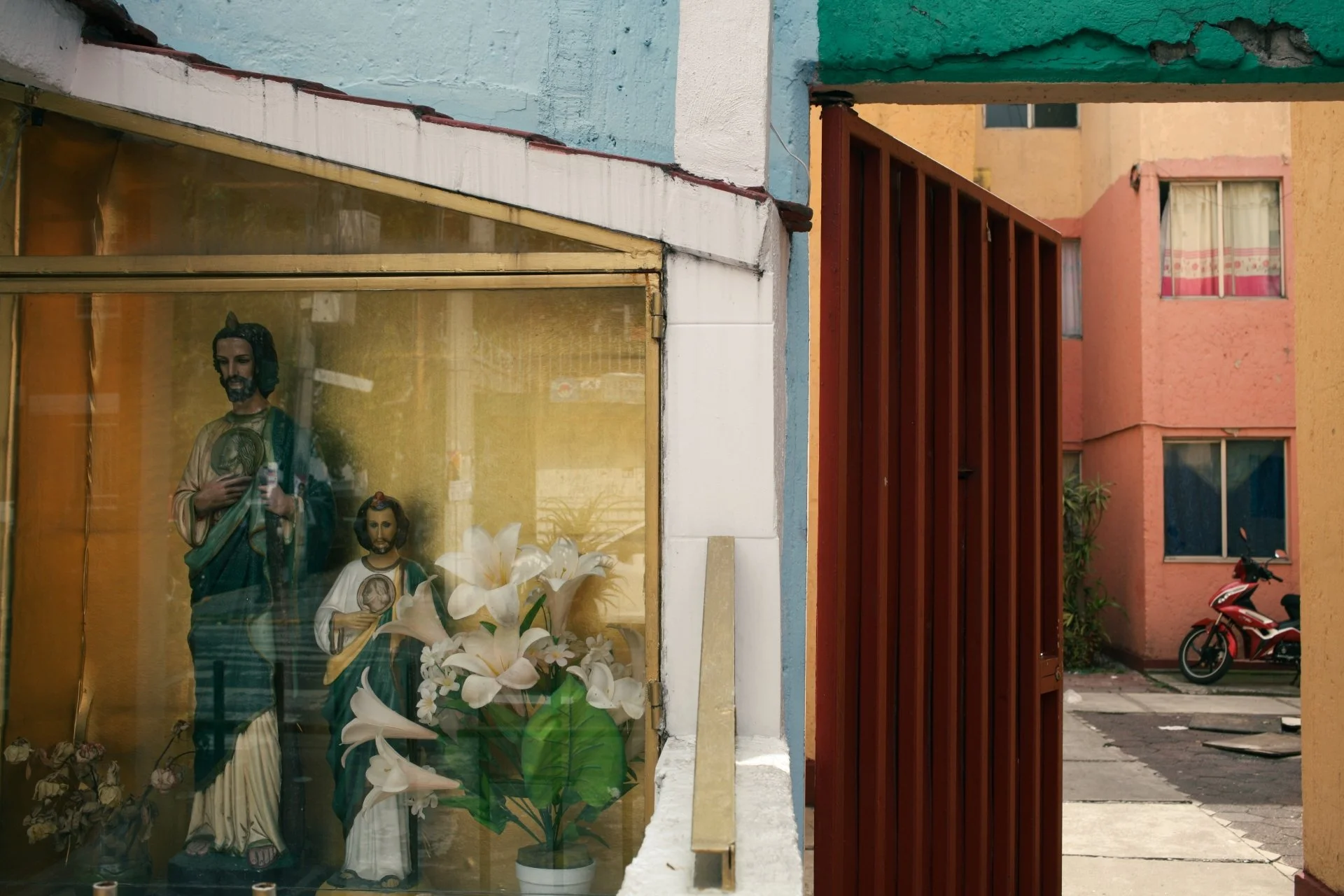
GEOGRAFIE: Anáhuac
Why GEOGRAFIE
First of all, let’s start with the project’s name. I chose the Italian word because I am Italian. Let’s start with the project’s name. I chose an Italian word because I am Italian. It creates an immediate connection to my constant pursuit of Qualsiasità, a concept coined by Cesare Zavattini. The allusion to Luigi Ghirri also seems evident to me.
But GEOGRAFIE is essentially an ongoing quest, a personal need to traverse certain places and view them in a particular way. The foundation of the project stems from the idea that the contemporary landscape is not something “natural,” but rather the result of layers, decisions, transformations, instances of abandonment, construction, and human traces.
The landscape as a human fact
GEOGRAFIE does not seek out monuments, iconic sites, or beautiful vistas. Instead, it looks for those ordinary places where the relationship between human beings and space becomes visible.
Human presence is latent, invisible most of the time, yet implied.
When nature dominates the landscape, this sense of presence persists, sustained by my gaze, which never merely surveys the scenery but instead weighs its inner dimension. In this sense, the project navigates a dichotomy between the physical (and thus material) landscape and the metaphysical one, linked to the realm of personal sensations.
The contemporary landscape is rarely neutral
The landscape is the result of accumulation: architecture, infrastructure, commerce, neglect, planning, improvisation. What interests me is precisely this condition, where the human presence can remain visible even when no human being is present.
In this sense, I feel very close to a certain tradition of Italian landscape photography, particularly to Luigi Ghirri and Guido Guidi, where the ordinary can become a subject without needing to be transformed into something exceptional.
This is a particularly interesting aspect to communicate and highlight, because it represents a clear departure from the typical nature of a street photographer: I am not interested in the decisive moment, but rather in the very negation of that Bressonian mantra.
Their photographs taught me that a place does not have to be spectacular to be worthy of attention. The landscape can reveal itself through a wall, a road, a building at the edge of a city, a fragment of architecture, or simply through the way things have been arranged.
And here is also something in the work of Gabriele Basilico that remains fundamental to my understanding of the city: the idea that architecture and urban space can be observed as traces of human presence, almost independently from the people who inhabit them.
Perhaps, from another geographical and cultural direction, Stephen Shore’s attention to the everyday offers another way of looking at the landscape: without hierarchy, without deciding in advance what deserves to be photographed.
GEOGRAFIE comes from somewhere between these ways of seeing, but it is not an attempt to reproduce them. It is an attempt to continue asking what happens when we look carefully at the places we normally pass without seeing. It is, exactly for this different approach, the awareness to photograph goes in contrasto with the idea that I need an event in order to take photographs.
So, with GEOGRAFIE, I would say I recognize a genealogy of the gaze I am referencing, but then, certainly, I am expressing my own perspective here, first and foremost because I am photographing at different latitudes.
A photograph of distance
Perhaps this project also stems from a need to step away from certain “obligations” of street photography, where you are practically required to get up close. In certain street dynamics, a strong compromise, accepting the inevitable, inevitably surfaces, to the point where the way one photographs rises from the gut. It can certainly be fun, and essentially, that is what I have done for decades.
At a certain poit I realized that I was not anymore attracted by that. I needed to slow down. I need my photography to become even more intentional.
I can see how in GEOGRAFIE The person is often not the subject. They may be absent, far away, or present only through what they have built. Photography thus becomes a form of observation rather than storytelling.
The journey
GEOGRAFIE cannot be constructed entirely from home. Some places must be reached. And this means traversing cities, suburbs, territories, back roads, industrial areas, neighborhoods, and seemingly insignificant landscapes.
The journey is therefore not an incidental component of the project. It is part of the method.
It exposes me to greater risks, obviously. I will increasingly find myself photographing in places I am visiting for the first time.
Time and Slowness
Fewer images, more attention: one image at a time.
Not necessarily “photographing less” as a moral rule, but letting the place determine how long to stay and when to take a picture.
GEOGRAFIE as an open project
The project will grow through different locations, and there are still so many GEOGRAFIE yet to be reached.
Some of these locations require time and travel. Continuing GEOGRAFIE therefore also means being able to reach territories that would otherwise remain outside the project. Every form of support simply helps make this work possible and allows it to reach a little further.
A project for myself
GEOGRAFIE is not simply a series of urban landscape photographs. It is an exploration of the way we inhabit and transform space.
And above all, it focuses on something that I feel the need to photograph.
A short programmatic manifesto
The territory as an archive
Every place preserves traces of what once was: architecture, fences, signs, roads, materials, and empty spaces. To photograph is also to read these remnants.
The ordinary as aesthetic material
I don’t seek the exceptional. GEOGRAFIE begins with what is normally not considered worthy of being photographed.
Between nature and artifice
The contemporary landscape is almost always a combination of the two: concrete, vegetation, infrastructure, sky, and buildings. These are not separate categories.
The city beyond the city
I don’t limit yourself to urban centers. Suburbs, fringes, transit areas, and seemingly anonymous territories can tell us far more than the “representative” city.
Distance as an aesthetic choice
Physical distance from the subject also creates emotional distance. Rather than necessarily entering the scene, observe it and let the place speak for itself.
Chance and attention
I don’t construct everything; much is simply found. GEOGRAFIE arises from the encounter between what is sought and what appears by chance along the way.
Traveling to see, not to collect places
This is important to me. It is not about adding destinations to a list, but about reaching places because they offer something to be observed.
Photography as a form of knowledge
I don’t photograph merely to produce images. I photograph to understand a place, its structure, its contradictions, and the relationship between what has been built and what remains.
The project’s timeframe
GEOGRAFIE does not need to be completed quickly. It is an exploration that can unfold over years, accumulating places, images, and connections. It is my lifetime project.
A personal atlas
GEOGRAFIE does not aim to be an exhaustive representation of the territory, but rather to slowly build a personal atlas of the contemporary landscape.
Beyond “important” images
A reflection on the hierarchy of the gaze: why do we always photograph certain places while completely ignoring others? GEOGRAFIE can challenge this very hierarchy.
The project as a journey
It is not only the final result that constitutes the project, but also the paths, periods of waiting, detours, returns, and places encountered along the way. In this sense, the journey becomes part of the work itself, rather than merely a logistical necessity.
The project is here already
I don’t consider GEOGRAFIE the usual photography prohject we are used to see. I view it more as a container for many different collections.
You can already see it here:
GEOGRAFIE is an open-ended project; by its very nature, it will continue to grow through places, encounters, journeys, and new photographs. Some of these places are close by, while others require time, roads to travel, and journeys to undertake.
I do not believe in crowdfunding as a way to support my work. I prefer to leave the choice entirely up to those who feel a connection to this project and wish, in some way, to contribute to its growth.
This could mean purchasing a print or a publication, joining one of my photography experiences, sharing the project, following its journey, or simply choosing to support it in whatever way feels right to them.
There is no set fee, formula, or tier of participation. Everyone is free to decide if and how they wish to contribute.
For me, this too is part of the project: building a direct relationship with the people who find something meaningful in the images and in the way I view these places.
GEOGRAFIE will continue in this spirit: one road at a time, one place at a time, one photograph at a time.
Thanks to be here.
Explore the project by clicking the button below.