How to Erase a Professional Photographer in One Contract
I need to share this recent story happened to me
A Note Before You Read
I have chosen not to disclose the name of the brand involved in this situation.
This is not about exposing a specific company or creating public friction. Large corporations often rely on standardized legal templates designed to maximize protection and minimize risk. That, in itself, is not unusual.
What interests me is not the identity of the brand, but the structure of the proposal.
Because the issue is systemic.
If I were to name the company, the conversation would immediately shift toward reputation, corporate behavior, or speculation about intent. That would distract from the real point: the contractual model itself.
This article is not about blaming. It is about examining a pattern that increasingly affects professional photographers.
The goal is not to attack.
It is to discuss openly what certain contractual structures imply for the sustainability, visibility and dignity of our profession.
The brand is secondary.
The model is the subject.
€1.40 Per Image Or How to Professionally Disappear
I have been working in professional photography for over a decade.
During these years I’ve collaborated with international brands, institutions and editorial platforms. I’ve built long-term relationships, delivered commissioned work, developed personal projects and taught photography across different countries.
This is my profession. Not a hobby. Not a side activity. Not “content creation.”
Recently, I received a contract proposal for a corporate street-style project.
The request was clear:
500 original photographs.
The compensation: €700.
Which means €1.40 per image.
That number alone is interesting. But let’s go further.
The contract required:
– Exclusive rights
– Worldwide usage
– A term of ten years plus an indefinite extension thereafter
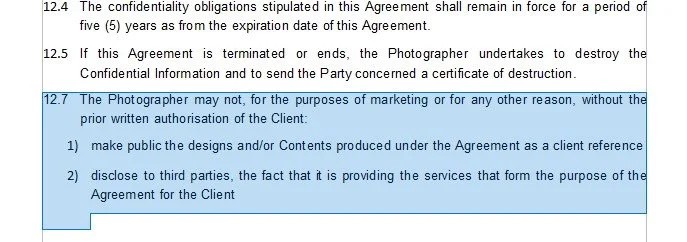
– A clause stating that I may not use the images in any manner whatsoever
– A clause preventing me from publicly stating that I worked for the client
So let’s summarize.
I would produce 500 original images.
The company would hold long-term exclusive control. I would receive €1.40 per photograph.
And I would not be allowed to show the work.
Or even say I created it.
There is something almost philosophical about this structure.
It is a model in which the photographer produces value but is contractually erased from its visible existence.
Now imagine something for a moment.
Imagine every brand acted this way.
Imagine every corporate contract prohibited photographers from:
– Showing commissioned work
– Using it in a portfolio
– Mentioning the collaboration
What would happen?
Professional photographers would slowly lose the ability to demonstrate their experience.
We would have no visible record of high-level collaborations.
No client references.
No evidence of trust built with serious companies.
From the outside, we would look exactly like anyone casually uploading images to Instagram or Flickr.
No context.
No credibility.
No professional history.
Just images floating online without narrative or legitimacy.
In other words, a photographer with fifteen years of international clients would appear indistinguishable from someone who picked up a camera six months ago.
That is not a healthy ecosystem.
Photography is not just the act of producing images.
It is also the accumulation of trust, reputation and professional trajectory.
When contracts remove both fair compensation and the possibility of professional attribution, they do not simply reduce fees.
They reduce visibility.
They reduce professional identity.
They reduce the structural sustainability of the field.
Let’s also be pragmatic.
Five hundred images represent:
Time on the street.
Selection.
Editing.
Delivery.
Responsibility.
Experience.
€1.40 per image does not reflect production costs. It does not reflect expertise. It does not reflect intellectual authorship.
It reflects a volume-based content logic.
And volume is the opposite of authorship.
This is not about outrage.
It is not about attacking a specific company.
Large corporations operate through standardized legal templates. That is normal.
But standard does not automatically mean fair.
If we normalize contracts where photographers are paid symbolic amounts for exclusive, long-term control while being prevented from even mentioning the collaboration, we are quietly accepting professional invisibility.
The question is not whether one photographer can refuse.
The real question is whether, collectively, we are willing to accept a system in which we generate value while being contractually edited out of our own professional story.
€1.40 per image is a number.
But what it represents is much larger.
It represents the difference between being treated as an author and being treated as a supplier of anonymous visual material.
And that difference matters.
Update: How This Story Actually Ended with the great fashion eyewear company
After publishing the video and writing the article, many of you asked me how the situation evolved.
Here is what happened.
After I raised my concerns about the contract - specifically about the inability to publicly declare the collaboration, the extreme exclusivity clauses, and the long-term usage rights for a symbolic fee - I was initially told that my requests would be accepted.
Shortly after, I received a “revised” version of the agreement.
The key clauses, however, remained unchanged:
The prohibition to publicly disclose that I was working for the client was still there.
The exclusivity over the images was still there.
The ten-year worldwide usage was still there.
The full indemnification obligations were still there.
In practical terms, nothing substantial had changed.
I replied again, asking for coherence between what had been communicated and what was written in the contract.
The final response I received was this: the requested changes could not be accepted. These conditions, I was told, are standard for all photographers they work with and cannot be modified for reasons of uniformity and fairness.
Let’s pause here.
Uniformity is not fairness.
Standardization is not balance.
If a clause is unbalanced, applying it to everyone does not make it ethical. It simply makes it consistently unbalanced.
For clarity, here were the core terms:
– 500 final images (lowered to 200 in the contract proposal update)
– 10 years worldwide internal usage
– Exclusive rights
– Full liability and indemnification obligations on the photographer
– €700 flat fee, all inclusive
No additional compensation.
No right to publicly declare the collaboration.
No meaningful control over future use.
At that point, I chose not to sign.
This was not a dramatic decision. It was a professional one.
This is not about one company. It is about a mindset that is becoming increasingly common: the idea that creative professionals should accept maximum restriction, maximum liability, and minimum compensation: in exchange for the symbolic value of working with a big name.
A contract is not just a legal tool. It is a cultural statement. It reveals how a company perceives the value of creative labor.
When a photographer is asked to disappear legally, publicly, and economically: that is not collaboration. That is erasure.
I am sharing this not out of resentment, but out of responsibility.
If we normalize these conditions, they become the baseline.
If we question them, we create space for better standards.
Every professional has the right to say no.
And sometimes, saying no is the most important part of protecting your work and your identity as an author.