
Process to a Photo that made the Cover of France Football
This photograph, as you know, made the cover of France Football, May 2026 issue.
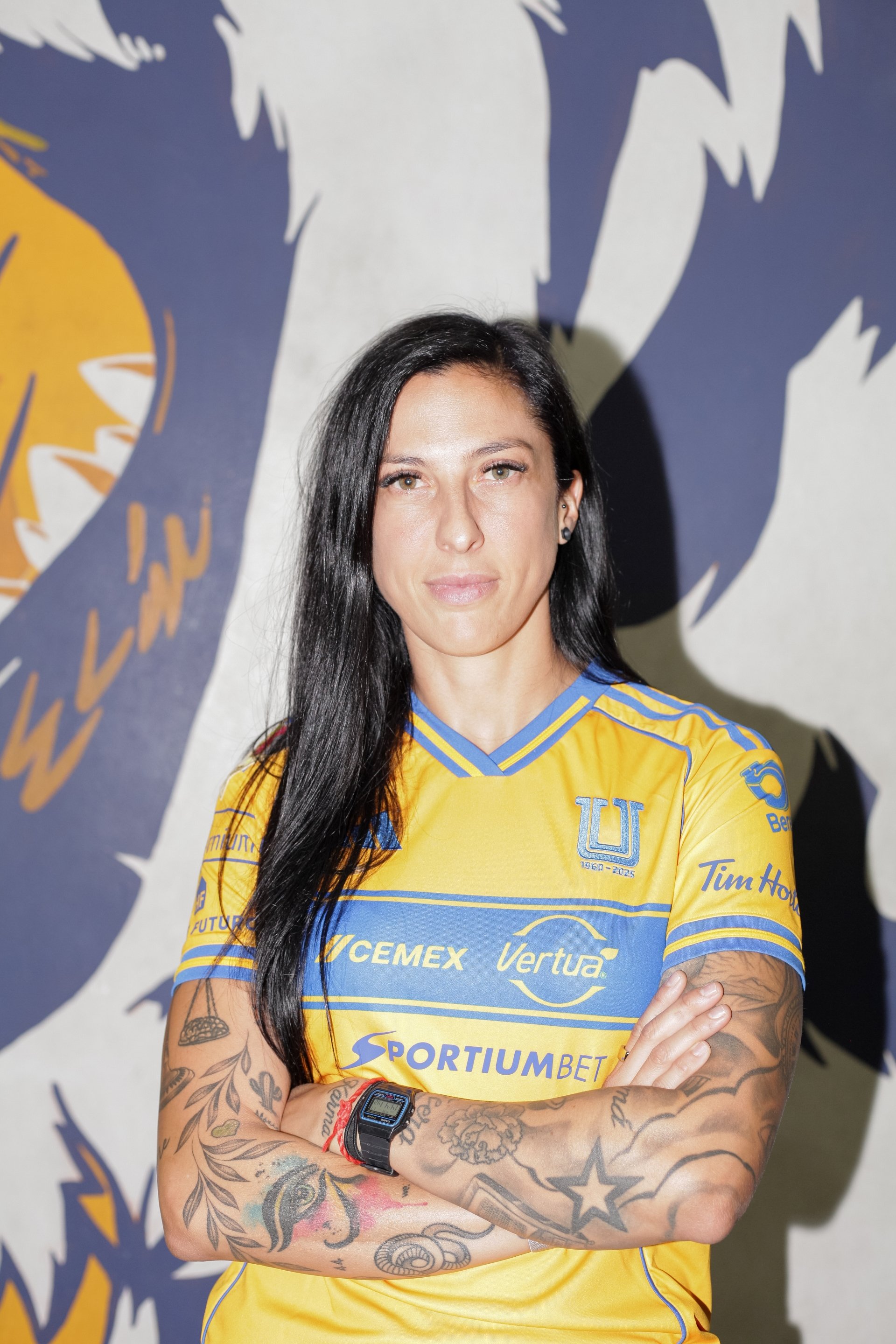
This photo didn’t come about under ideal conditions. I had about ten minutes, a dark gym, and lighting that would be flattered if called terrible. There was no time to stage anything, and I didn’t even try to pretend otherwise.
I’m not here to defend it: it has already graced the cover of France Football and doesn’t need me. It isn’t even a "beautiful" photo, at least not in the usual sense of the word, and I don’t believe photos have to be. A beautiful photo is admired and then forgotten. A photo that challenges you stays with you.
That’s why I chose, and actively sought, a snapshot aesthetic. No soft lighting, no studio perfection. I wanted a direct, almost raw image: Jennifer Hermoso looking into the camera with her arms crossed, wearing her Tigres jersey, tattoos visible, watch on her wrist, unsmiling and giving nothing away.
And then there’s the shadow on the wall behind her. It’s no accident. Knowing Jennifer’s story, that shadow cannot be random, at least not in my vision. It is something that follows her, something she didn’t choose and that won’t go away, even when she is standing right there in front of you, looking you straight in the eye. The cover headlin. *Plus rien ne peut me faire taire* ("Nothing can silence me anymore"), uts into words what the image tries to convey in silence.
I don’t expect anyone else to see it the way I do. It’s enough for me if that shadow makes people wonder what lies behind it.
Imperfection as language
As I said this is not a beautiful photograph. At least, not in the sense we usually use that expression. It is not a polished, reassuring image constructed to satisfy a conventional idea of photographic quality. It does not try to completely hide the conditions under which it was created. And I am not interested in judging it solely on the basis of its technical execution. I believe photographs do not necessarily have to be beautiful. They need to be capable of doing something: leaving a trace, raising a question, provoking a sense of unease, or perhaps even dividing their viewers. A photograph that begins and ends with immediate pleasure may be agreeable, but it does not necessarily have much else to say. Conversely, an imperfect image can hold a tension that a formally flawless photograph fails to achieve.
This is where the snapshot aesthetic comes into play.
Because a snapshot is not simply a photograph taken in haste. Nor is it an excuse for technical sloppiness. It is a way of approaching the photographic image that challenges the notions of absolute control, perfectly resolved composition, ideal lighting, and that quest for a polished finish we often mistake for quality. It is a photograph that can retain something direct, raw, and seemingly unresolved, something that belongs to the moment, but also to the photographer's own gaze. And the history of photography has repeatedly shown us just how powerful this language can be. Consider Nan Goldin and her unguarded intimacy, images that seem to emerge from within life itself rather than observing it from a safe distance. Consider Daido Moriyama, the grain, the blur, the extreme contrasts, and a style of photography that seems to capture the chaotic energy of the street. In both cases, imperfection is not necessarily a flaw to be corrected. It can become an expressive choice, an essential part of the visual language. Naturally, I do not wish to equate such vastly different photographic experiences, nor do I claim that any imperfect photograph automatically holds value. Imperfection, in itself, means nothing. The difference lies in what that imperfection manages to communicate and the relationship it establishes with the subject.
In Jennifer Hermoso’s photograph there is an element that matters more to me than any consideration of lighting or technical quality: the shadow. Knowing Jennifer’s story, that shadow is not accidental in my view. It is not an element I consider merely in terms of composition, nor a detail to be eliminated to make the portrait "cleaner." To me, it introduces a second layer of meaning to the image. It adds tension and suggests something that is not explicitly stated. It does not attempt to tell a whole story; instead, it leaves room for the possibility that, behind a face, there is something beyond what we see. The shadow is not a caption. It does not explain, demonstrate, or attempt to summarize a person’s experience. It is a visual choice that, n my interpretation of the portrait, gains significance precisely through an understanding of the context. Without that context, it might be merely a formal element. With that context, it becomes a narrative possibility. And that is precisely what interests me about photography: the possibility of leaving a door open without necessarily dictating what we must find on the other side.
When I speak of a "snapshot aesthetic," I am not referring to a formula to be applied to images. It does not mean taking bad photos, ignoring technique, or turning every limitation into a supposed virtue. Rather, it means accepting that control is not always the most important value. Sometimes, it is necessary to know when to stop chasing the perfect photograph and start looking at what photography, with all its limitations, is already capable of revealing to us. Ten minutes, a dark gym, challenging lighting. Those were the conditions. I could have viewed them merely as obstacles. Instead, I tried to work within that reality, without trying to turn it into something it wasn't. And the result is ths photograph that doesn't need to please me in every respect. Nor does it need to please everyone. I am far more interested in the possibility that someone might stop to look at it, wonder why that shadow is there, and try to read the image beyond its surface. A cover is an editorial outcome. A photograph, however, can be something more than the result for which it was commissioned. And I am so happy the photo editor gets it.
It can be an image that keeps asking questions even after the job is done. That is the important thing. And no, i am not into photography to make pretty pictures. Never been that.
Not always seeking a photograph that demonstrates how skilled we are at taking pictures, but one that has something to say. Even when it does so imperfectly.
THANKS
I would like to take this opportunity to thank those who entrusted me with various commissioned projects this year. I have reached my fifth magazine cover in 1 year, all for international print publications. This is a special year that marks a truly significant professional shift.