
Returning to the Same Place: Time, Change, and the Quiet Power of Repetition
In contemporary photography there is a persistent temptation to move forward constantly, to search for new places, new subjects, new visual surprises. Yet one of the most meaningful gestures a photographer can make is often the simplest: returning to the same place.
PHOTO 1
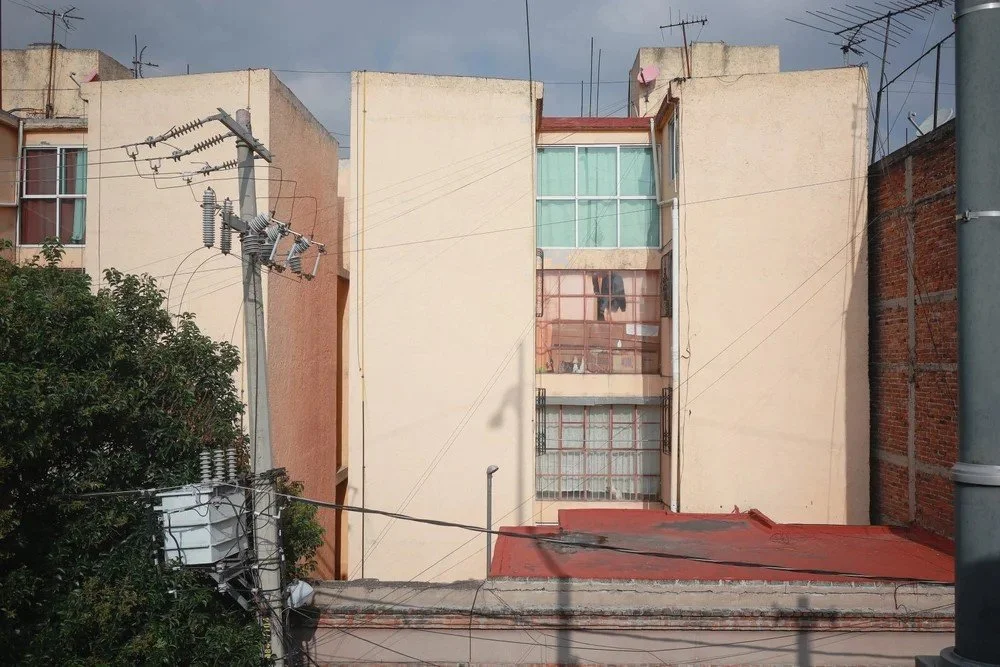
PHOTO 2
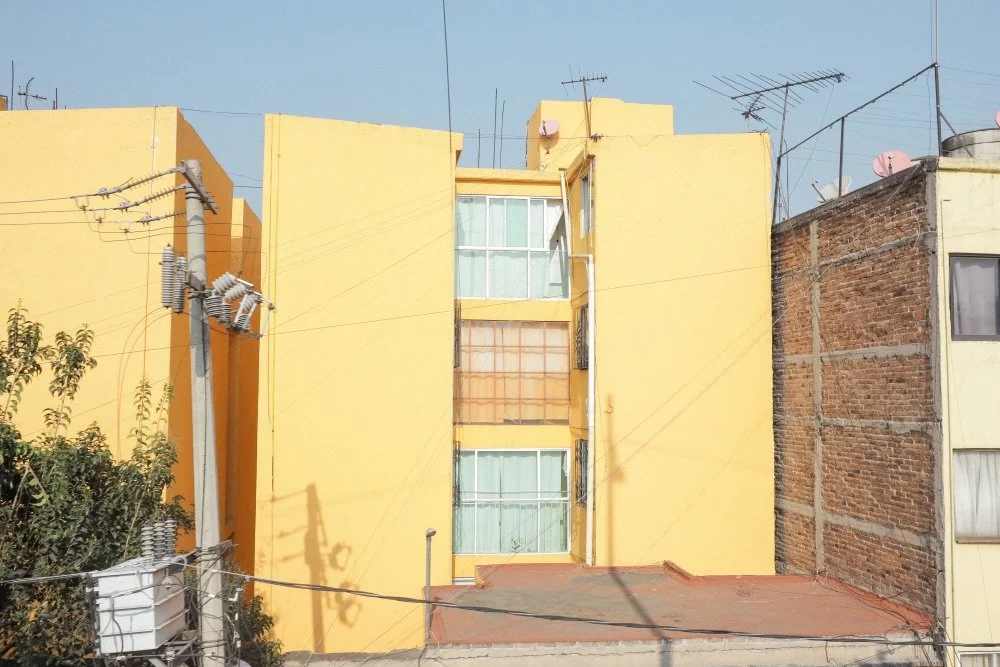
The two images above show the same building, photographed from the same viewpoint. The architecture has not changed. The cables, antennas, balconies and surrounding structures remain almost identical. And yet the scene is unmistakably different. The building has been repainted. What was once a pale, neutral façade has become a vivid yellow surface.
This seemingly minor alteration transforms the entire visual structure of the photograph.
The Documentary Value of Repetition
Within the tradition often associated with new topographic photography, returning to the same location is not merely a practical exercise. It becomes a method of observation.
Landscapes, especially urban ones, rarely change through dramatic events. More often they evolve through subtle, incremental modifications: a coat of paint, a new sign, a removed tree, a different window covering. Individually these changes appear insignificant, but over time they accumulate and redefine the character of a place.
By photographing the same view repeatedly, the photographer builds a visual archive of these transformations. The camera becomes a quiet instrument of record. It captures not only what exists, but how it slowly shifts through time.
This kind of work resists spectacle. Instead, it values patience and attentiveness.
The Metaphysical Dimension of Looking Again
But repetition is not only documentary. It also carries a metaphysical dimension.
Returning to the same place forces the photographer to confront the act of seeing itself. What has changed? What remained unnoticed before? How does light, color, or atmosphere alter the emotional weight of an otherwise identical scene?
In the first photograph, the building’s muted façade blends with the surrounding tones. The composition feels restrained, almost austere. In the second image, the yellow paint introduces a new visual tension. The structure becomes more assertive within the frame, interacting differently with the sky, the brick wall beside it, and the network of cables crossing the scene.
The architecture remains the same, yet the photograph becomes something else.
This reveals a fundamental truth about landscape photography: places are never entirely fixed. They exist in a continuous dialogue with time, maintenance, decay, and human intervention.
I think also the sky contruibutes in a different perception. In the first photo it is cloudy and therefore the scene feels dark, almost threatening, with a sense of oppression. In the second photograph everything appears happier also because of the weather conditions, which are sunnier.
Photography as an Act of Return
For photographers like me, working within an observational tradition, the act of return becomes essential.
Revisiting a location allows the photographer to move beyond the excitement of discovery and enter a deeper relationship with the environment. The place becomes familiar, almost intimate. Small variations become visible. Subtle shifts gain significance.
Over time, repetition transforms a simple photograph into part of a longer visual narrative.
The building in these images is not simply an architectural subject. It becomes a marker of time. A surface where change quietly announces itself.
And perhaps this is one of photography’s most enduring strengths: its ability to reveal that even the most ordinary places are never truly the same.
They are always becoming something else.
A Personal Note: Photographing the Same Place as a Portrait of Myself
Returning to the same place is not only a documentary gesture for me. It is also something more personal, almost introspective.
When I photograph a building like this one, from the same position, at different moments in time, I am obviously recording a transformation in the urban landscape. The color changes. The atmosphere changes. The visual balance of the scene shifts. These are objective facts, and they belong to the documentary dimension of photography.
But at the same time, something else is happening.
Each time I return to the same location, I am not exactly the same photographer who stood there before. My experience has changed. My visual sensitivity has evolved. The way I relate to the city is slightly different. In that sense, repeating a photograph also becomes a way of measuring my own transformation.
The place becomes a mirror. And the sense of place changes because I am always different. It can be the mindset, the general mood, what I am listening while I am photographing.
This is why I do not see repetition as a limitation or a lack of imagination. On the contrary, it is a way of slowing down the photographic process and deepening my relationship with the environment. Instead of constantly searching for new subjects, I prefer to build a dialogue with the spaces I encounter.
Urban landscapes are often treated as static backgrounds, but they are anything but static. They are living structures, constantly modified by small human decisions: repainting a wall, adding a window covering, repairing a façade. These minimal interventions gradually reshape the visual identity of the city. And my perception of theplace changes so it will not be the same photograph.
Photographing these subtle changes allows me to observe the slow rhythm of urban life.
At the same time, it allows me to understand my own way of seeing. If someone were to look at these repeated photographs over many years, they would not only see the evolution of a building. They would also see the evolution of my gaze.
In this sense, the act of returning becomes almost autobiographical.
The landscape records time.
But the photograph records the photographer as well. Like a portrait.