

 Image 1 of 1
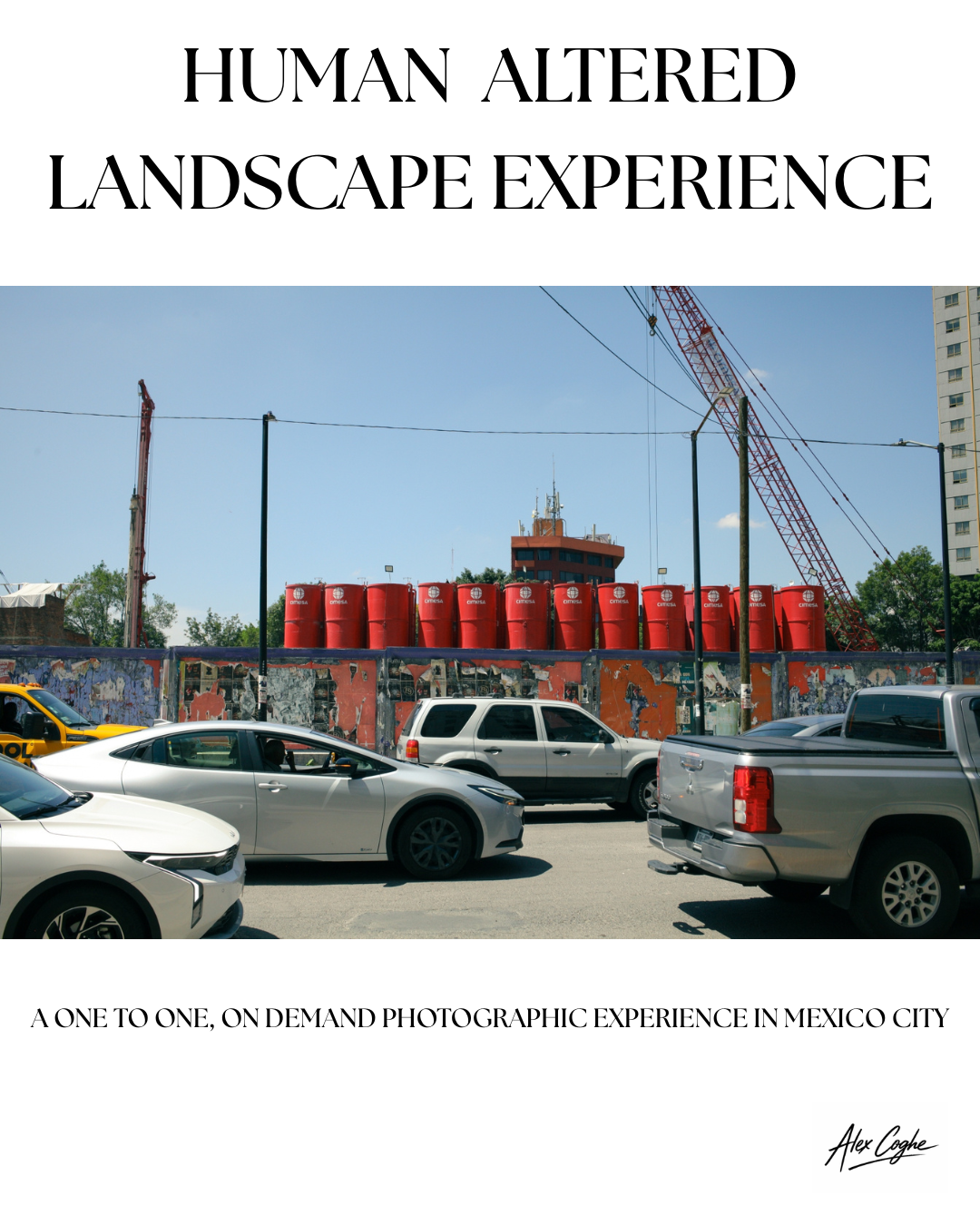
HUMAN ALTERED LANDSCAPE EXPERIENCE
A One to One, On Demand Photographic Experience in Mexico City
4 Hours / US$500
8 Hours / US$900
The city is not only made of buildings, streets and people.
It is made of everything humans have done to it.
Walls, signs, sidewalks, fences, advertisements, empty lots, architecture, colors, traces, constructions, demolitions, interventions, accidents, repetitions and contradictions.
Human Altered Landscape is a one to one photographic experience dedicated to the urban landscape and to the traces of human presence within it.
This is not a traditional street photography workshop.
It is an invitation to slow down, observe and photograph the city differently.
THE IDEA
The photographic landscape does not have to be spectacular.
In fact, some of the most interesting photographs can be found in places that appear completely ordinary.
A wall.
A parking lot.
A building facade.
A discarded object.
A construction site.
A strange combination of colors.
A piece of architecture surrounded by nothing.
A trace left behind by someone who is no longer there.
The challenge is to recognize these things as photographic subjects.
The experience is rooted in a long tradition of photographic observation, from Luigi Ghirri and Stephen Shore to William Eggleston, Lewis Baltz and Gabriele Basilico, among others.
But this is not a workshop about imitating those photographers.
Their work provides a starting point for a much more personal question:
What does the city look like when you stop looking for photographs and start learning to see?
ONE PERSON. ONE CITY. ONE WAY OF SEEING.
This experience is deliberately one to one.
There is no group.
There is no fixed route.
There is no predetermined list of locations that we simply have to visit.
Instead, we work together to develop a photographic approach that responds to your own interests, your way of seeing and the particular character of Mexico City.
The city becomes our laboratory.
Depending on your interests, we may work with architecture, peripheral spaces, ordinary neighborhoods, commercial areas, modern developments, historical layers, empty spaces, signs, color, geometry, repetition, visual accidents or the relationship between natural and constructed elements.
The route is part of the photographic process.
ONE CAMERA. ONE LENS.
I strongly believe that seeing becomes clearer when the equipment becomes simpler.
For this reason, I encourage you to work with one camera and one lens.
Not because other equipment is wrong, but because changing lenses and searching for the “right” focal length can easily become a distraction.
The objective is to learn how to make the photograph with what you have.
The limitation becomes part of the language.
WHAT WE WILL WORK ON
During the experience, we will explore:
Seeing the ordinary
Learning to recognize photographic possibilities in places that initially appear insignificant.
The altered landscape
Understanding how human intervention transforms the visual character of a place.
Space and emptiness
Using negative space, distance and absence as active elements of the photograph.
Architecture and the everyday
Looking beyond architecture as an object and photographing its relationship with the surrounding environment.
Color and visual relationships
Exploring unexpected relationships between colors, surfaces, signs and objects.
Geometry and structure
Working with lines, shapes, repetition, scale and visual tension without relying on conventional compositional formulas.
The photographic frame
Understanding how small changes in position, distance and perspective can completely transform an ordinary scene.
The difference between seeing and photographing
Perhaps the most important part of the experience.
The goal is not simply to make more photographs.
It is to become more conscious of why you are making them.
MEXICO CITY AS A PHOTOGRAPHIC LABORATORY
Mexico City is particularly suited to this approach.
It is a city where different periods, architectural languages and forms of human intervention constantly overlap.
Modernist buildings coexist with colonial structures.
New developments appear beside abandoned spaces.
Commercial signs compete with architecture.
Color, concrete, vegetation, infrastructure and human traces constantly collide.
There is no need to search for a picturesque Mexico City.
We can photograph the city that is actually there.
And sometimes the most interesting photograph is hiding in plain sight.
HOW IT WORKS
Before the experience, we will establish what you are interested in exploring and what kind of photographic questions you want to investigate.
We then spend 4 or 8 hours photographing together in Mexico City, walking and observing rather than simply moving from one “photogenic” location to another.
The itinerary is flexible and can change according to what we encounter.
Photography is not a race.
Sometimes we may spend several minutes in front of a single scene.
Sometimes we may walk for twenty minutes without taking a photograph.
Both are part of the process.
At the end of the experience, we can review and discuss some of the photographs made during the session, looking at what worked, what did not, and where your personal visual language might be developing.
THIS EXPERIENCE IS FOR YOU IF...
You are interested in photography beyond simply photographing people.
You are fascinated by cities and the visual traces humans leave behind.
You enjoy the work of photographers such as Ghirri, Shore, Eggleston or Basilico.
You want to develop a more personal relationship with the urban landscape.
You feel that you photograph too quickly and want to learn how to slow down.
You want to understand how an ordinary place can become a meaningful photograph.
Or perhaps you simply want to spend several hours looking at Mexico City with another photographer who will challenge you to see things differently.
THIS IS NOT...
A sightseeing tour.
A conventional street photography tour.
A technical photography class.
A predetermined photo walk.
A search for famous Mexico City landmarks.
A competition to produce the largest number of photographs.
There is no formula here.
There is only observation, exploration and the attempt to discover your own way of seeing.
THE EXPERIENCE
HUMAN ALTERED LANDSCAPE is available exclusively as a private, one to one experience.
4 HOURS — US$500
A concentrated half-day exploration of Mexico City's altered landscape.
8 HOURS — US$900
A full-day photographic immersion, allowing more time for exploration, experimentation and deeper visual research.
Both formats are on demand, meaning that we arrange the date and schedule directly according to availability.
Maximum participants: 1
This is your city walk, your camera, your questions and your way of seeing.
Mexico City is already full of photographs.
The challenge is to see the ones that nobody else is looking at.
A One to One, On Demand Photographic Experience in Mexico City
4 Hours / US$500
8 Hours / US$900
The city is not only made of buildings, streets and people.
It is made of everything humans have done to it.
Walls, signs, sidewalks, fences, advertisements, empty lots, architecture, colors, traces, constructions, demolitions, interventions, accidents, repetitions and contradictions.
Human Altered Landscape is a one to one photographic experience dedicated to the urban landscape and to the traces of human presence within it.
This is not a traditional street photography workshop.
It is an invitation to slow down, observe and photograph the city differently.
THE IDEA
The photographic landscape does not have to be spectacular.
In fact, some of the most interesting photographs can be found in places that appear completely ordinary.
A wall.
A parking lot.
A building facade.
A discarded object.
A construction site.
A strange combination of colors.
A piece of architecture surrounded by nothing.
A trace left behind by someone who is no longer there.
The challenge is to recognize these things as photographic subjects.
The experience is rooted in a long tradition of photographic observation, from Luigi Ghirri and Stephen Shore to William Eggleston, Lewis Baltz and Gabriele Basilico, among others.
But this is not a workshop about imitating those photographers.
Their work provides a starting point for a much more personal question:
What does the city look like when you stop looking for photographs and start learning to see?
ONE PERSON. ONE CITY. ONE WAY OF SEEING.
This experience is deliberately one to one.
There is no group.
There is no fixed route.
There is no predetermined list of locations that we simply have to visit.
Instead, we work together to develop a photographic approach that responds to your own interests, your way of seeing and the particular character of Mexico City.
The city becomes our laboratory.
Depending on your interests, we may work with architecture, peripheral spaces, ordinary neighborhoods, commercial areas, modern developments, historical layers, empty spaces, signs, color, geometry, repetition, visual accidents or the relationship between natural and constructed elements.
The route is part of the photographic process.
ONE CAMERA. ONE LENS.
I strongly believe that seeing becomes clearer when the equipment becomes simpler.
For this reason, I encourage you to work with one camera and one lens.
Not because other equipment is wrong, but because changing lenses and searching for the “right” focal length can easily become a distraction.
The objective is to learn how to make the photograph with what you have.
The limitation becomes part of the language.
WHAT WE WILL WORK ON
During the experience, we will explore:
Seeing the ordinary
Learning to recognize photographic possibilities in places that initially appear insignificant.
The altered landscape
Understanding how human intervention transforms the visual character of a place.
Space and emptiness
Using negative space, distance and absence as active elements of the photograph.
Architecture and the everyday
Looking beyond architecture as an object and photographing its relationship with the surrounding environment.
Color and visual relationships
Exploring unexpected relationships between colors, surfaces, signs and objects.
Geometry and structure
Working with lines, shapes, repetition, scale and visual tension without relying on conventional compositional formulas.
The photographic frame
Understanding how small changes in position, distance and perspective can completely transform an ordinary scene.
The difference between seeing and photographing
Perhaps the most important part of the experience.
The goal is not simply to make more photographs.
It is to become more conscious of why you are making them.
MEXICO CITY AS A PHOTOGRAPHIC LABORATORY
Mexico City is particularly suited to this approach.
It is a city where different periods, architectural languages and forms of human intervention constantly overlap.
Modernist buildings coexist with colonial structures.
New developments appear beside abandoned spaces.
Commercial signs compete with architecture.
Color, concrete, vegetation, infrastructure and human traces constantly collide.
There is no need to search for a picturesque Mexico City.
We can photograph the city that is actually there.
And sometimes the most interesting photograph is hiding in plain sight.
HOW IT WORKS
Before the experience, we will establish what you are interested in exploring and what kind of photographic questions you want to investigate.
We then spend 4 or 8 hours photographing together in Mexico City, walking and observing rather than simply moving from one “photogenic” location to another.
The itinerary is flexible and can change according to what we encounter.
Photography is not a race.
Sometimes we may spend several minutes in front of a single scene.
Sometimes we may walk for twenty minutes without taking a photograph.
Both are part of the process.
At the end of the experience, we can review and discuss some of the photographs made during the session, looking at what worked, what did not, and where your personal visual language might be developing.
THIS EXPERIENCE IS FOR YOU IF...
You are interested in photography beyond simply photographing people.
You are fascinated by cities and the visual traces humans leave behind.
You enjoy the work of photographers such as Ghirri, Shore, Eggleston or Basilico.
You want to develop a more personal relationship with the urban landscape.
You feel that you photograph too quickly and want to learn how to slow down.
You want to understand how an ordinary place can become a meaningful photograph.
Or perhaps you simply want to spend several hours looking at Mexico City with another photographer who will challenge you to see things differently.
THIS IS NOT...
A sightseeing tour.
A conventional street photography tour.
A technical photography class.
A predetermined photo walk.
A search for famous Mexico City landmarks.
A competition to produce the largest number of photographs.
There is no formula here.
There is only observation, exploration and the attempt to discover your own way of seeing.
THE EXPERIENCE
HUMAN ALTERED LANDSCAPE is available exclusively as a private, one to one experience.
4 HOURS — US$500
A concentrated half-day exploration of Mexico City's altered landscape.
8 HOURS — US$900
A full-day photographic immersion, allowing more time for exploration, experimentation and deeper visual research.
Both formats are on demand, meaning that we arrange the date and schedule directly according to availability.
Maximum participants: 1
This is your city walk, your camera, your questions and your way of seeing.
Mexico City is already full of photographs.
The challenge is to see the ones that nobody else is looking at.