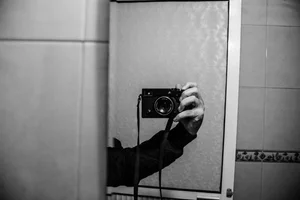

Racism, Classism and Hypocrisy in Photography
For some time now I have been thinking about a contradiction that I see quite often in the photographic world, and honestly, I find it increasingly difficult to ignore.
Many photographers are just posers. They act as sensitive people but they are not really that. They are qite the opposite: racist, classist and they vote the far right, supporting the grim, neoliberal capitalism
There are photographers who spend their careers talking about empathy, human dignity, community, and the importance of understanding other people, while their attitudes in everyday life tell a completely different story. They photograph poor people, marginalized communities, migrants, and all kinds of human situations, presenting themselves as sensitive observers of the world, but then, outside photography, they look at those same people with a sense of superiority, when not with open contempt. Some of them are wealthy, or at least comfortably established, and move almost exclusively within privileged social circles. There is nothing wrong with being successful or having money. The problem is the attitude that often comes with it, the idea that people who have less are somehow worth less, that poverty is a personal failure, and that the privileges one enjoys are simply the natural reward for being smarter, more capable, or somehow better than everyone else.
I find this particularly disturbing when the same photographers build their public image around empathy and social awareness. They speak about the importance of getting close to people, of understanding their lives, of looking beyond appearances. Yet the moment these people are no longer in front of their cameras, the empathy seems to disappear. And there is where I can see all of that is just a pose.
I have seen enough of this kind of contradiction to believe that we should talk about it more openly.
Because Photography has a strange capacity to make people look better than they actually are. A photographer can spend years documenting poverty and inequality, publish books, receive awards, and become an important name in the photographic community, while holding political and social views that are completely at odds with the humanism they claim to represent. And somehow, we are expected to separate everything, to admire the work and leave the rest alone, as if the person behind the camera had nothing to do with the meaning they give to their own practice. I have never found this particularly convincing. Of course, I know that a photograph does not tell us everything about the person who made it, and I have no intention of judging the quality of someone's work simply because they vote differently from me. But when a photographer constantly speaks about human rights, solidarity, and social justice, I think it is legitimate to look at their political choices and ask ourselves how those choices fit with the values they publicly defend. Because politics is not something that exists somewhere far away from our everyday lives. Political decisions affect people's access to healthcare, education, housing, employment, and basic social protection. They determine who receives help, who is left behind, and who is considered deserving of a decent life. When someone supports political parties whose policies are openly hostile to migrants, the poor, workers, and vulnerable people, I find it difficult to take their declarations of solidarity at face value, especially when those declarations are also part of their professional identity.
For me, this becomes even more troubling when racism and classism are involved. We are talking about people who may photograph a person from a different background with apparent sensitivity, only to support political movements that treat people like that as a problem to be contained, excluded, or blamed for society's difficulties. The photograph becomes a kind of alibi, a way of presenting oneself as open minded and compassionate while remaining comfortable with the inequalities that shape the lives of others. And the photographic world often helps this happen. Photographers are celebrated, invited into prestigious circles, included in books, festivals, and exhibitions, and sometimes elevated to a kind of hall of fame, while very little attention is paid to the contradictions between their public image and their actual attitudes. We seem to care a great deal about their photographs and considerably less about the world they want to help create through their political choices.
I find this hypocrisy difficult to accept.
Perhaps it is because I have always considered photography a way of looking at the world, and I have never been able to separate that act of looking entirely from the way we understand other people. I do not believe that making photographs automatically makes anyone more sensitive, more intelligent, or more humane. I have met people who can speak beautifully about photography and produce remarkable work, yet show very little curiosity or respect for anyone outside their own social environment. Being a photographer is a profession, a practice, perhaps even a way of life. It is not a moral achievement in itself.
I also want to be clear about where I stand politically, because I have no interest in pretending to be neutral on questions that I consider fundamental.
My own position is rooted in an anarcho socialist sensibility, in a rejection of class privilege as a measure of human worth, and in the belief that society should be organized around people's needs rather than the endless accumulation of wealth. I believe in solidarity, in strong public services, in workers' rights, and in a state that takes responsibility for ensuring that everybody has the possibility of living a dignified life. I have always found the Scandinavian and Nordic social democratic traditions interesting in this regard, despite their limitations and contradictions. The idea that healthcare, education, social protection, and decent living conditions should be accessible to everyone seems to me a reasonable starting point for any society that takes human dignity seriously. This does not mean that everybody must have the same life, the same income, or the same ambitions. It means that the circumstances of one's birth should not determine whether one has access to the basic conditions for a decent existence. I don’ t consider this an extravagant demand. I certainly don’t consider it some kind of dangerous communist fantasy. I see it as a question of what kind of society we want to live in and what responsibilities we have toward one another.
And this is precisely where I find the classism of certain photographers so revealing. They can spend their professional lives photographing people who struggle to survive, but the idea of supporting a political system that redistributes resources, protects workers, or makes essential services available to everyone suddenly becomes unacceptable. Their empathy seems to have very clear limits, and those limits often coincide with their own economic interests. I cannot help wondering what kind of empathy we are talking about in such cases.
I am not asking photographers to turn every project into a political statement, and I have never believed that photography needs to illustrate an ideology to have value. My own work moves through different subjects and approaches, and I have no interest in reducing photography to a political slogan. But I do think that the way we treat other people, the assumptions we make about them, and the political choices we support tell us something important about who we are. And I believe that the photographic community should be more willing to acknowledge this.
There is something deeply uncomfortable about celebrating someone for their supposed sensitivity toward humanity while ignoring their contempt for people who happen to be poorer, darker skinned, foreign, or socially less privileged. It becomes even more uncomfortable when that person uses their photographic reputation to speak with authority about precisely the issues on which their own behavior raises serious questions. And I am tired of the idea that a photographer's public image should be protected simply because their work is considered important. We can recognize someone's contribution to photography without turning them into a moral reference point. We can appreciate photographs while remaining critical of the people who make them. And we should be able to discuss these contradictions without being accused of mixing art and politics every time the discussion becomes inconvenient.
What interests me is not the private life of every photographer, nor am I interested in policing people's opinions. What interests me is the gap between the values people claim to represent and the values they actually support. When that gap becomes too wide, I think we have every reason to question the credibility of their public image. After all, the people we photograph have their own lives, their own political realities, and their own struggles. They are not there to make us look sensitive. They don’t exist to provide us with meaningful projects, prestigious publications, or the opportunity to build a reputation around our supposed understanding of the human condition. They deserve respect regardless of whether they ever appear in a photograph.
I would like to see a photographic community that takes these questions seriously, one that is less impressed by prestigious names and more willing to examine the relationship between photography and the society in which it exists. We spend so much time discussing equipment, aesthetics, projects, careers, and recognition. Perhaps we should spend a little more time thinking about the people we photograph and the kind of world we are helping to sustain. For me, this is not a question of being morally superior to someone else. It is a question of consistency, and of refusing to accept that empathy can be something we perform in public while practising its opposite in our everyday lives.
If we speak about human dignity, we should take human dignity seriously. If we photograph people living in difficult circumstances, we should at least question the political choices that make those circumstances more difficult. And if we claim to care about equality, we should be prepared to examine our own relationship with privilege. I do not expect photography to make us better people. But I do expect photographers who build their reputations around humanism to understand that the word has a meaning beyond the photographs they produce.
And I refuse to believe that asking for a society in which everyone has the possibility of a dignified life is asking too much.
All over these years I met brand executives, photographers and photo editoris that vote for racist and classist parties. They, in fact, support a certain kind of system where dignity of person, respect for human rights are menaced constantly.
Photography can tell us a great deal about the world. What we do with that understanding, and how we choose to treat the people who inhabit it, is another matter entirely. My intention with this article and the accompanying YouTube video is to express my discontent, my dissent, and my utter contempt for all those photographers—and others within the world of photography—who are, in fact, classist and racist, and who uphold a capitalist model that represents the ruin of humanity.