
On the commodification of recognition, the concentration of cultural power, and the political contradictions of contemporary photography.
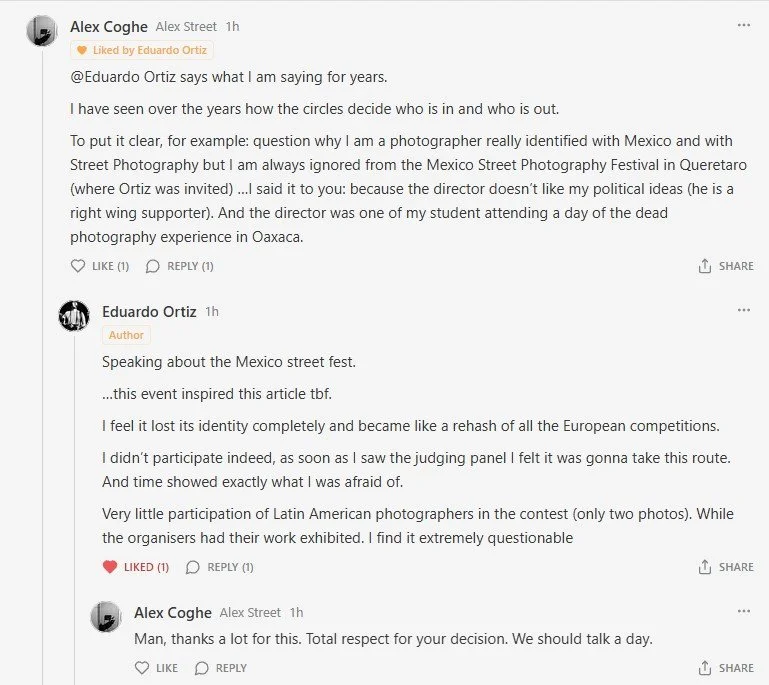
This article was inspired by Eduardo Ortiz piece on substack . I consider myself a big fan of Eduardo’s work and I invite you to follow him on substack and on youtube.
There comes a point when a practice becomes so normalised that questioning it begins to look like heresy. In contemporary street photography, one of these practices is paying to enter competitions, submitting work to festivals, purchasing the possibility of recognition, and treating a shortlist, an award, or an exhibition as evidence that one's photography has somehow acquired greater value. Photographers do it every day. They pay entry fees, prepare submissions, study previous winners, follow the careers of jurors, and wait for an email that might validate months or years of personal work. Some win. Most do not. Many try again. This way the industry calls this participation. I would like to suggest another term: the commercialisation of photographic insecurity.
The problem is not simply that some competitions are expensive, that certain juries make questionable decisions, or that the same photographers appear repeatedly among the winners. These are symptoms of a larger structural problem. We have created an ecosystem in which recognition is increasingly treated as a scarce commodity, access to it is monetised, and photographers are encouraged to invest their money and creative energy in the hope of receiving institutional approval. Meanwhile, the institutions distributing that approval accumulate fees, visibility, cultural authority, and prestige.
Who benefits from this arrangement?
And why have so many photographers accepted it as a necessary part of their artistic and professional lives?
1. From photographic practice to a market for recognition
To understand the problem, we need to move beyond individual competitions and examine their political economy. A photographer produces work. A competition offers the possibility of exposure. The photographer pays an entry fee. The organisers receive revenue, whether or not the photographer is selected. The selected photographers receive a degree of visibility, which can subsequently be used to pursue further opportunities. The competition, in turn, promotes its winners, strengthens its reputation, and attracts future applicants. The cycle reproduces itself. This does not mean that every competition is exploitative or that every organiser acts in bad faith. Some offer meaningful opportunities, transparent procedures, substantial exhibitions, or financial rewards that justify their costs. These distinctions matter. But the underlying economic arrangement deserves scrutiny. In many competitions, the financial risk is distributed among numerous applicants, while the benefits of prestige and institutional visibility are concentrated among a much smaller group.
The photographer pays for the possibility of being recognised. The organiser monetises that possibility. This is where the language of political economy becomes useful. Recognition is not merely an aesthetic judgement. It can function as symbolic capital, in Pierre Bourdieu's sense: a form of socially recognised prestige that can be converted into professional opportunities, invitations, publications, and further recognition. Once recognition becomes a form of capital, the institutions that distribute it acquire economic and cultural power. The question is no longer simply whether a photograph is good. It is who possesses the authority to declare it good, which mechanisms confer that authority, and who is able to benefit from the declaration.
A photograph does not become more meaningful because somebody has charged its maker for the opportunity to be selected.
Yet the contemporary competition economy repeatedly encourages photographers to behave as though institutional recognition were an essential stage in the development of their work.
It is not.
2. Photofeudalism and the concentration of cultural power
Eduardo Ortiz's discussion of photofeudalism provides a useful framework for understanding this situation. Drawing on the concept of technofeudalism popularised by Yanis Varoufakis, Ortiz identifies a concentration of influence within the street photography ecosystem. Festivals, jurors, curators, competition organisers, and established photographers form an interconnected network through which recognition circulates. The same names appear on judging panels, in exhibitions, among award recipients, and in the promotional material of other institutions. Previous recognition becomes a qualification for future recognition. Visibility generates more visibility.
This is a form of cumulative advantage.
The system does not need to be centrally coordinated, deliberately corrupt, or governed by explicit agreements to produce unequal outcomes. Familiarity, professional relationships, reputational shortcuts, and the understandable desire of organisers to associate themselves with established names can reproduce the same hierarchy without anybody needing to issue an instruction. The result is a cultural economy in which those who already possess visibility are better positioned to acquire more of it. Meanwhile, photographers outside these networks must work harder to gain attention, often spending money on submissions that offer no guarantee of meaningful exposure. This is not an argument that established photographers lack merit. Many are excellent. It is an argument against confusing accumulated recognition with an objective measurement of artistic value.
A photographer may be repeatedly selected because their work is exceptional. They may also benefit from familiarity, established relationships, or an aesthetic that has become institutionally legible. These possibilities are not mutually exclusive. The problem arises when the system treats its own previous decisions as evidence that its next decisions must be correct.
Recognition then becomes self-validating.
The institution recognises a photographer because other institutions have recognised them. The next institution recognises them because the previous institution did. The photographer's accumulated prestige becomes an increasingly powerful argument for further prestige. And the people who remain outside the cycle are expected to keep paying for the opportunity to enter it. This is the feudal logic of the arrangement: a concentration of power over the distribution of a resource that others need in order to advance. In this case, that resource is visibility.
3. The Mexico Street Photography Festival: a local case with wider implications
Eduardo Ortiz's criticism of the Mexico Street Photography Festival deserves particular attention because it brings these questions into a specific cultural context. In his response to my comment, Eduardo explained that the festival itself had inspired his article. He wrote that he felt the event had lost its identity and become a repetition of European competitions. He chose not to participate after seeing the judging panel, anticipating that the event would follow precisely the direction he feared. He subsequently pointed to the limited participation of Latin American photographers in the contest, reporting only two photographs, while members of the organising team had their own work exhibited. He considered this situation extremely questionable.
These observations raise legitimate questions about representation, institutional independence, and the relationship between a festival's stated identity and its actual practices.
The reported participation figures, considered on their own, cannot establish why particular photographers were selected or excluded. We would need the total number of submissions, their geographical distribution, the selection criteria, and other relevant information to draw firm conclusions. Likewise, organisers exhibiting their own work does not automatically establish misconduct. It does, however, make transparency and clear safeguards against conflicts of interest particularly important.
These qualifications do not weaken the criticism. They clarify precisely what needs to be examined.
Why establish a festival dedicated to Mexican street photography if the resulting selection offers so little visible participation from Latin American photographers? What role does the judging panel play in defining the festival's aesthetic identity? How are decisions made when organisers may also benefit from the platform's cultural authority? What mechanisms exist to ensure that the institution is accountable to the photographic community it claims to serve? I think these are not peripheral questions. They concern the purpose of the institution itself.
A festival does not become culturally meaningful merely by operating in Mexico or adopting a national identity. Its significance depends, in part, on the visual languages it supports, the communities it engages with, and the extent to which it creates opportunities beyond those already available through established international networks. A local festival that reproduces the same aesthetic hierarchies as the international competitions it might have challenged risks becoming a local distributor of external legitimacy rather than an independent cultural platform.
The contradiction is particularly striking when a festival's geographical identity promises diversity, while its selection practices appear to offer little space for that diversity to become visible. The issue is not that Mexican photographers must be favoured simply because a competition takes place in Mexico. That would replace one narrow criterion with another. The issue is whether the institution genuinely expands the field of photographic possibilities or merely reproduces an established hierarchy under a different geographical label.
Cultural diversity cannot be reduced to a location, a flag, or a line in a festival's promotional statement. It must exist in the work that the institution makes visible.
4. The aesthetics of institutional power
The political economy of photographic recognition has consequences beyond money and professional opportunity. It can also influence the photographs themselves. When certain aesthetic approaches are repeatedly rewarded, they acquire institutional legitimacy. Other approaches may remain marginal, not necessarily because they are less interesting, but because they are less compatible with the expectations that have become established within a particular competition culture. In contemporary street photography, this can mean an emphasis on visual spectacle, immediately legible compositions, strong colour contrasts, unusual coincidences, and images that deliver their effect almost instantaneously. There is nothing inherently wrong with these qualities. Spectacular photographs can be excellent photographs. Strong colour, visual complexity, and decisive composition are not problems in themselves.
The problem is the reduction of photographic value to a relatively narrow set of recognisable effects.
Photography can also be quiet, ambiguous, uneventful, politically uncomfortable, visually unresolved, or resistant to immediate interpretation. It can explore the relationship between people and architecture, the ordinary transformations of urban space, the traces of social inequality, or the subtle absurdities of everyday life. It can operate through sequences, long-term observation, visual restraint, and the accumulation of meaning across images rather than through a single spectacular frame. These approaches may be difficult to evaluate through a competition format designed to reward individual images that produce an immediate impact.
When photographers begin anticipating what juries will reward, the institution no longer merely evaluates photography after it has been made. Its expectations can begin to influence the conditions under which photography is made. The photographer starts looking for images that might win rather than images that demand to be made. And this is how institutional power can become internalised as aesthetic self-discipline. The photographer may believe they are pursuing their own artistic development, while increasingly adjusting their work to an imagined audience of jurors, curators, and festival directors. The result is not necessarily deliberate imitation. It is something subtler: a gradual narrowing of the photographer's imagination around what is already recognised as legitimate.
A supposedly open competition can therefore contribute to the homogenisation of the very practice it claims to celebrate.
The danger extends beyond street photography. Documentary photography is also affected when complex social realities are reduced to images that are easily consumed, immediately understood, and institutionally rewarded. The market for recognition can favour photographs that package social experience into a familiar visual language, while making less spectacular, more ambiguous, or structurally critical work harder to circulate. And when this happens, the question is no longer only who gets to exhibit. It is which forms of looking are encouraged to survive.
5. Paying to participate: the financial filter
Photography competitions frequently describe themselves as open, democratic, and accessible. Anyone can submit work. Anyone can theoretically win. But formal access is not the same as equal access. Entry fees accumulate. Some photographers can afford to submit work to dozens of competitions, travel to festivals, print portfolios, and maintain a sustained presence within professional networks. Others cannot. The difference is not necessarily talent, commitment, or the quality of their work. It may simply be disposable income, geographical proximity, available time, or access to professional contacts.
A pay-to-enter system therefore introduces a financial filter before the aesthetic judgement even begins.
That filter may be relatively small in each individual competition. Across an entire year, however, the costs can become substantial. Photographers may spend hundreds or thousands of dollars pursuing opportunities whose probabilities of success are difficult to assess and whose long-term professional benefits remain uncertain. The opportunity cost is not merely financial. It is also creative. Time spent preparing submissions, monitoring announcements, studying juries, and pursuing the next award is time that could be spent making photographs, editing a coherent body of work, studying the history of the medium, or developing relationships with the communities being photographed. The language of investment makes this arrangement sound reasonable. Pay the fee, submit the work, increase your chances, build your profile.
But an investment normally invites questions about expected returns, risk, and opportunity cost. Why do photographers so rarely apply the same critical scrutiny to competitions that they would apply to other professional expenditures? What else could that money support? Film, printing, books, travel, time away from paid work, or simply the freedom to continue photographing without having to justify the practice through external recognition? The system encourages photographers to invest in their own visibility while directing resources towards institutions that control the terms on which that visibility is distributed. From a socialist perspective, this is a familiar contradiction: the individual is encouraged to compete for access to a scarce resource instead of questioning why the resource is organised in such a way. Photographers become competitors for recognition rather than participants in a shared cultural practice. The result is a fragmented community in which each individual is encouraged to pursue private advancement through the very structures that reproduce collective inequality. The institutions do not need to promise success. They need only preserve the possibility of success, because that possibility is what sustains participation.
The product being sold is not necessarily an award. It is the hope of becoming somebody who wins one.
6. The loser is not the photographer who refuses to participate
Let us address an uncomfortable question directly. What does it mean to be successful in photography? If success is defined exclusively through awards, festival selections, institutional exhibitions, and the recognition of established gatekeepers, then the answer is straightforward: photographers must compete for those things, and those who fail to obtain them are positioned as less successful. But who established that definition? A photographer who spends years observing a neighbourhood, producing a meaningful documentary project, developing an independent visual language, or building a sustainable professional practice may never win a major street photography award. Does that make the work less valuable? Conversely, does winning a competition automatically establish a photographer's long-term significance?
The absurdity becomes apparent as soon as we stop confusing the recognition of a particular institution with the value of photography itself. There is nothing inherently shameful about entering a competition or being pleased to receive an award. Photographers are human beings, and recognition can be gratifying. Awards can occasionally create opportunities that would otherwise be difficult to access. But there is a substantial difference between occasionally using a competition as one possible means of circulating work and organising one's photographic life around the pursuit of institutional approval.The latter is a trap. The real loser is not necessarily the photographer who enters a competition and fails to win. Nor is every photographer who pays an entry fee foolish or complicit in an exploitative system.
The losing proposition is accepting that your work needs to be validated by a commercialised hierarchy before you can regard your photographic practice as meaningful.
It is allowing the possibility of being selected to determine what you photograph, how you photograph it, and how you judge yourself. It is spending money you cannot comfortably afford in the hope that an institution will give you permission to believe in your work. It is mistaking visibility for value, prestige for substance, and institutional approval for artistic independence. The most radical response is not to become better at playing this game. It is to question why the game has become so central to the way photographers understand their own work.
7. The political hypocrisy of the photographer
There is another contradiction we need to address, one that goes beyond festival fees, judging panels, and the concentration of cultural power. It concerns the political beliefs of photographers themselves.
Street photography and documentary photography are often presented as practices rooted in curiosity about the world, attention to human experience, and an engagement with the social conditions in which people live. They bring us into contact with public space, inequality, labour, poverty, migration, social conflict, and the everyday realities of people whose lives are rarely represented on their own terms. Yet some photographers who claim this humanistic tradition simultaneously support political movements whose documented policies or public rhetoric promote exclusionary nationalism, stigmatise migrants, reinforce racial hierarchies, or oppose measures intended to reduce economic inequality.
I think this contradiction deserves to be examined.
You cannot claim to be interested in the human condition while refusing to question the structures that determine whose lives are valued, whose suffering is ignored, and whose presence is treated as a problem.
Photography does not automatically make anyone progressive. Owning a camera, documenting strangers, or producing images of poverty does not confer moral authority. A photograph can reveal inequality, but its maker can remain indifferent to the conditions that produce it. A documentary project can depict marginalised people while its author supports political positions that contribute to their marginalisation. The camera does not absolve its operator of political responsibility. Nor should we assume that every photographer who supports a conservative party is necessarily racist or classist. Political affiliations are complex, and specific claims must be examined through actual policies, public statements, and actions rather than convenient labels. The relevant question is what those positions defend, whose interests they serve, and how they relate to the photographer's professed values.
When a photographer supports policies that discriminate against particular groups, legitimise racial hierarchies, or systematically disadvantage working people, while simultaneously presenting their photographic practice as an expression of universal empathy, the contradiction is not merely personal. It concerns the relationship between representation and political action. Who are we photographing? Why are we photographing them? What do we believe about their place in society? And what happens when the people represented in our photographs belong to groups whose rights or dignity our political commitments undermine? These questions cannot be answered by pointing to a powerful image of a poor neighbourhood, a migrant, or a working-class family. Representation is not solidarity in itself. Looking at people is not the same as recognising their equality.
There is also a class dimension to the photographic establishment. Festivals, awards, publications, and cultural institutions do not exist outside the material conditions of society. Access to them depends partly on money, time, education, geographical mobility, and professional networks. Their hierarchies can reproduce inequalities that extend far beyond photography. A photographer who denounces exclusion in an image but treats cultural privilege as a natural entitlement should at least be willing to confront that inconsistency.
Likewise, a festival that celebrates diversity in its promotional language while failing to examine who has access to its platforms should be questioned about the relationship between its declared values and its institutional practices. The point is not to demand ideological conformity from every photographer or to turn photographic criticism into a political loyalty test. It is to reject the convenient fiction that artistic practice exists in a moral vacuum. Photography is made within society. Its institutions distribute resources and recognition within society. The political values of the people who control those institutions can influence the priorities they establish, the communities they engage with, and the forms of inequality they choose to challenge or ignore. A genuinely critical photographic culture must therefore be capable of examining not only images, but also the social relations surrounding their production, circulation, and recognition.
If photography teaches us to look carefully at the world, it should also encourage us to examine the positions from which we look.
Empathy cannot remain an aesthetic performance. If it means anything, it must eventually confront the political and economic conditions of other people's lives.
8. Beyond the competition economy
Criticising the existing system is not enough. We must also consider what a different photographic culture might look like. Festivals and competitions that charge entry fees should disclose their financial structures as clearly as possible. Applicants should know what their fees support, how selections are made, what the judges' roles are, whether organisers may benefit directly from the competition, and what selected photographers can realistically expect in return. Conflicts of interest should be addressed through transparent procedures. If organisers exhibit their own work, that relationship should be disclosed, and the selection process should be demonstrably independent where appropriate. Cultural institutions should question the geographical and aesthetic concentration of their networks. This does not mean introducing quotas without regard to context or merit. It means actively examining whether their existing methods of discovering work systematically overlook photographers, communities, and visual traditions outside familiar networks.
Photographers should also develop alternatives to the competition economy. Independent publications, artist-run spaces, collaborative exhibitions, self-published books, local photographic communities, direct relationships with editors, and sustained documentary projects can all provide ways to circulate work without making awards the primary measure of achievement. None of these alternatives is automatically free from economic inequality or institutional gatekeeping. Independent publishing costs money. Galleries have their own hierarchies. Editors make subjective decisions. Social networks can reproduce exclusion just as easily as festivals.
There is no perfectly neutral cultural space.
The objective, therefore, is not to replace one set of gatekeepers with another. It is to diversify the channels through which photographs can be encountered, discussed, published, and preserved. A healthy photographic culture requires multiple centres of judgement, different forms of distribution, and the freedom to produce work that does not conform to the expectations of any single institution. It also requires a change in how photographers relate to one another. Instead of treating every other photographer as a competitor for limited recognition, we can share knowledge, recommend work, create independent platforms, support publications, and build communities in which the value of a photograph is not determined by its ability to win a prize.
This is not an argument against ambition. It is an argument for directing ambition towards the work itself rather than towards the institutions that promise to reward it.
9. Stop asking permission
I have worked as a professional photographer for years, and I have no interest in pretending that professional recognition is irrelevant. Publications, editorial assignments, clients, and meaningful professional relationships matter. Photography is also a way of making a living, and nobody should be expected to romanticise financial insecurity. But professional work and the pursuit of photographic awards are not the same thing. An editor commissioning a photographer for a specific assignment is paying for a service and a particular body of expertise. A publication presenting a coherent documentary project is making an editorial decision. A competition charging applicants for the opportunity to be selected operates under a different economic arrangement. These distinctions should not be blurred.
Nor should we assume that rejecting the competition economy means rejecting every form of institutional recognition. The point is to establish a hierarchy of our own priorities rather than inherit one from the industry.My work does not become more meaningful because a festival selects it. It does not become less meaningful because a jury ignores it. Its value must be examined through the photographs themselves, the questions they raise, the relationships they establish with the world, and the coherence of the practice from which they emerge.That does not mean every photograph is equally successful, that criticism is irrelevant, or that photographers should become immune to judgement. On the contrary, serious photographic practice requires criticism, historical knowledge, self-questioning, and a willingness to confront the limitations of one's own work.
But criticism and institutional validation are not interchangeable. We should seek serious dialogue about photography, not simply the approval of people who happen to occupy positions of influence. We should read books, study photographers across generations and geographical boundaries, examine the history of documentary practice, and develop the capacity to make informed judgements independently of the latest shortlist. Above all, we should remember that photography existed before the contemporary festival economy and will continue to exist without it.
The photographs that matter to us were not made because their makers anticipated a future competition. They emerged from curiosity, necessity, observation, commitment, experimentation, and sometimes simple pleasure. A camera is not an application form. A photograph is not a bid for admission. A body of work is not a résumé waiting to be approved.
10. A different kind of photographic politics
The deeper issue is not whether festivals are good or bad. It is whether photography should be organised primarily around competition for scarce institutional recognition or around the development of a plural, critical, and accessible visual culture. The former encourages individual advancement within existing hierarchies. The latter asks how photographic knowledge, opportunities, resources, and audiences can be distributed more widely. A socialist approach to photography does not require pretending that every photographer has the same abilities or that every image has equal artistic merit. It requires questioning the concentration of cultural power, the commodification of access, and the assumption that existing hierarchies are natural or inevitable.
It also requires recognising that culture is produced collectively, even when photographs are made individually. Photographers learn from other photographers, inherit visual traditions, depend on publishers and editors, engage with the people they photograph, and work within social conditions they did not create. The mythology of the solitary photographic genius obscures these relationships. So does the mythology of the competition winner, whose institutional recognition is presented as though it were the natural culmination of an entirely individual struggle.
When the same networks repeatedly determine which work receives visibility, the cultural field risks confusing the reproduction of privilege with the reproduction of excellence. When access is monetised, financial capacity becomes part of the mechanism through which photographers pursue recognition. When a narrow aesthetic becomes dominant, the diversity of photographic expression is diminished. These are not separate problems. They reinforce one another.
The alternative begins by refusing to accept that the existing distribution of visibility is the natural measure of photographic worth.
It begins by supporting work because it deserves attention, not because an institution has already declared it important. It begins by creating opportunities that do not require every aspiring photographer to pay for a chance to be chosen. And it begins when photographers recognise that their collective interests may be better served by challenging the competition economy than by fighting one another for a place within it.
Conclusion: The most radical award is indifference
Eduardo Ortiz's criticism of the Mexico Street Photography Festival raises questions that extend far beyond a single event. His concerns about aesthetic homogenisation, limited Latin American participation, and the relationship between organisers and exhibitors point towards a broader problem: the concentration of cultural authority in a system that presents itself as open while repeatedly rewarding familiar forms of recognition. These concerns should be investigated, not dismissed. They should also lead us to examine our own participation in the wider economy of awards, festivals, and paid submissions. We cannot demand a more plural photographic culture while unquestioningly financing structures that may narrow the conditions under which photographic work becomes visible.
We cannot complain about the dominance of established networks while treating admission to those networks as the ultimate measure of success. And we cannot defend photographic independence while allowing the anticipation of a jury's approval to become an organising principle of our practice. The solution is not to declare war on every festival or to condemn every photographer who enters a competition. It is to withdraw the automatic legitimacy we grant these institutions, evaluate their actual contribution, and stop treating their recognition as a prerequisite for meaningful work. Paying to submit a photograph is a choice. Refusing to do so can be a choice, too. The important thing is that the decision should emerge from an understanding of the system rather than from the fear of being left behind.
If a competition offers a genuinely worthwhile opportunity, evaluate it critically. If it does not, keep your money. Make photographs. Read. Print. Publish. Build relationships. Support other photographers. Develop a body of work that can withstand scrutiny without needing the endorsement of a festival director or a judging panel. The point is not to prove that we can win the game. It is to stop accepting that the game defines us.
Let the festivals distribute their medals. Let the juries publish their shortlists. Let the same names circulate through the same international networks, if that is what those institutions choose to do. We have photographs to make, histories to investigate, lives to document, and visual languages to develop that cannot be reduced to a ranking. We should not need to purchase the possibility of being told that our work matters. And if an entire photographic culture depends on persuading us that we do, perhaps it is time to stop paying attention. Perhaps it is time to stop paying, full stop.
Not because every photographer who enters a competition is a loser, but because a photographic culture that teaches its practitioners to buy the possibility of recognition has made insecurity part of its business model.
We don’t have to keep financing it.
The revolution begins when we stop confusing the gate with the destination.