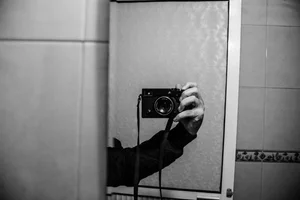

Today marks the conclusion of another teaching experience, this time with Centro Cultural SER, where I taught The Art of Seeing Through Street Photography. The course was conducted primarily online, with today's final session dedicated to photographic practice on the streets.
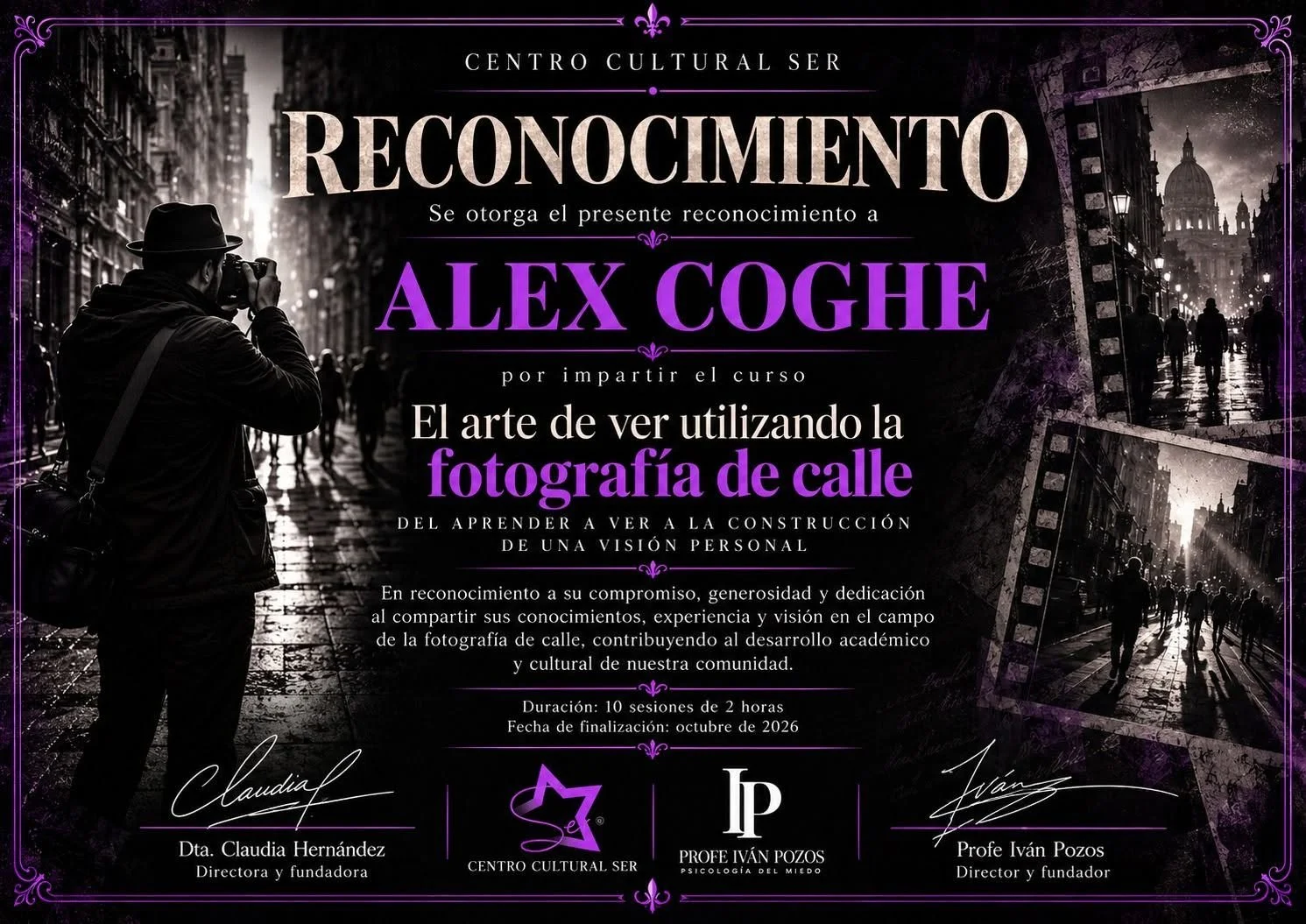
And let me say this from the beginning: there will be more.
Over the course of nearly twelve lessons, I developed and shared a program built around a conviction that has accompanied me throughout my photographic practice and teaching career: technique is only a small part of photography.
Photography is often approached as a discipline governed by rules, technical procedures, and compositional formulas. Much of the conversation revolves around camera settings, equipment, exposure, and the supposedly correct way to make a photograph. These things have their place, of course, but they cannot explain what photography really is, what makes an image meaningful, or why certain photographs remain with us long after we have seen them.
I wanted to build a course that moved beyond this limited understanding of the medium.
Rather than offering a collection of rules to follow, I designed a program focused on developing a visual foundation. We explored photography through ontological and semiotic perspectives, examining what an image is, how it produces meaning, how we interpret photographs, and how our own experiences, cultural references, and ways of seeing shape that interpretation.
The objective was not simply to teach students how to photograph, but to encourage them to think about photography, to question what they see, and to become more conscious of the decisions they make when approaching an image.
I believe photography deserves this kind of attention. Too often, it is treated as a subject that requires little thought beyond the practical application of technical knowledge. Sometimes, looking at the way photography is taught, I am reminded of aggiustaggio, a subject I encountered during my years at technical industrial school. The word refers to a kind of mechanical fitting and adjustment, and I have never quite forgotten it. There is something profoundly limiting about reducing photography to a comparable process, as though making an image were simply a matter of adjusting the right components until everything works.
Photography is a language, a way of thinking, a means of interpreting the world. It can be approached philosophically, culturally, historically, and emotionally. Its technical dimension matters, but it is only one element within a much larger field of possibilities.
This is the perspective I wanted to bring to Centro Cultural SER.
Throughout the course, I shared references, ideas, and approaches that have become an integral part of my own photographic practice. These are not abstract notions detached from the act of photographing. They inform the way I observe, the decisions I make, the images I produce, and the way I understand the relationship between photography and reality.
Teaching also means returning to the foundations of one's own knowledge, articulating ideas that may have developed over many years of looking, reading, photographing, and reflecting. It means making explicit what experience has gradually taught us. In that sense, every teaching experience is also an opportunity to reconsider one's own practice.
After nearly twelve lessons, I can honestly say that I feel proud of what we have built. There is a particular satisfaction in being able to share not just technical information, but a way of approaching photography that leaves room for curiosity, critical thinking, and the development of an individual visual language.
At the conclusion of the course, Claudia Hernández and Iván Pozos, directors and founders of Centro Cultural SER, shared these words:
“We would like to express our sincere gratitude to Alex Coghe for being part of Centro Cultural SER and for teaching the course ‘The Art of Seeing Through Street Photography.’
Thank you for generously sharing your experience, knowledge, and, above all, a way of looking at photography that goes far beyond technique. Throughout these lessons, students were able to approach street photography through observation, intention, composition, and the development of their own unique perspective.
It was a true privilege to have you as an instructor and to have opened this space for learning, reflection, and photographic practice.
We deeply appreciate your commitment, availability, and everything you have contributed to our community.
We hope this will be the first of many collaborations and that we will have the opportunity to work together again very soon on new projects at Centro Cultural SER.”
Claudia Hernández, Director and Founder
Iván Pozos, Director and Founder
Centro Cultural SER
I am grateful for these words and for the opportunity to have developed this course within their educational community. It is particularly meaningful to see the emphasis placed not merely on the technical aspects of photography, but on observation, intention, reflection, and the development of an individual perspective. These are precisely the elements I wanted to put at the center of the experience. For me, teaching photography has never been simply about transmitting information. It is about opening possibilities, providing tools for understanding images, and encouraging photographers to discover what they want to say through their work. There is no single correct way to look at the world, just as there is no single correct way to photograph it.
The challenge is to develop a personal relationship with the medium, one that is informed by knowledge but not constrained by formulas. Tomorrow, with a little distance from the experience, I will inevitably start thinking about what could be improved. There is always something to reconsider, something to refine, another reference to introduce, or another way to approach a subject. That is part of the process, both as a photographer and as an educator. But today, I want to allow myself to enjoy the result.
I am proud of this course, of the ideas we explored, and of having had the opportunity to contribute to a space where photography could be approached as a cultural practice and a form of thought. And this is not the end. There will be other courses, other conversations, and other opportunities to explore what it means to see through photography.
For today, that is more than enough.